As the crowning event of Flores de Mayo, a month-long Catholic devotion honoring the Virgin Mary, the Grand Santacruzan brings together faith, tradition, and spectacle in one grand procession. But what happens when an avant-garde designer takes on one of the celebration's most anticipated presentations?
Designer Axel Que returned to the "Grand Santacruzan sa Sugbo 2026" after several years away from the annual procession, bringing with her a collection that was both personal and purpose-driven. Since joining the event in 2016, Que has witnessed her own creative evolution unfold alongside the tradition. Once labeled "too avant-garde" for religious celebrations, she returned to the procession with two striking ternos — one for the Zagala queen and another for her escort.
Rooted in Zero-Waste Design
Rooted in zero-waste design and shaped by her Muslim-Cebuano heritage, Que reimagined the Santacruzan as a platform for sustainable couture. Her design included barongs salvaged after Typhoon Tino damaged her shop, leaving behind piña-embroidered pieces that she carefully rebuilt into new forms. "The focus was making the design sustainable," Que shared. "Nothing should be wasted." That philosophy was evident throughout the side-by-side collection, which Que unveiled for the first time in an interview with SunStar Lifestyle.

The Zagala Queen's Gown
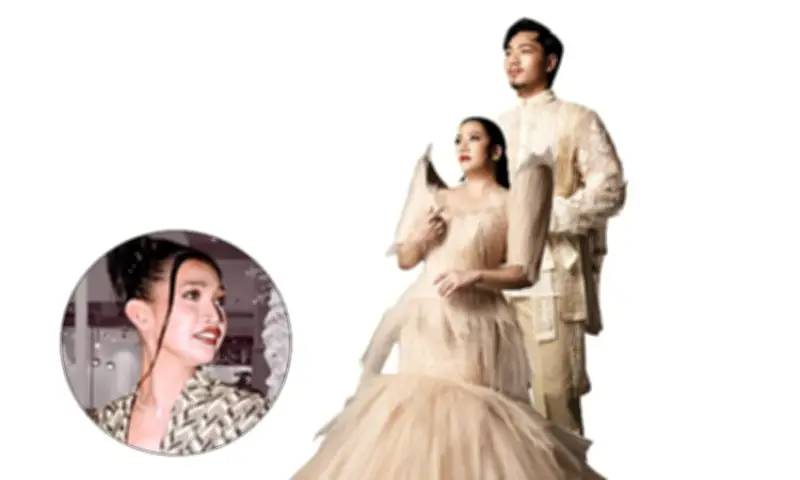
The queen's gown and escort ensemble departed from the vibrant colors typically associated with the Santacruzan, instead embracing soft nude beige and ivory tones. Dramatic pleated sleeves, layers of French tulle, and corseted construction created an undeniably regal presence while maintaining Que's signature contemporary edge. Architect and environmental planner Jehanne Frances Dy-Cruz, who portrayed Reyna Sheba, experienced that attention to detail firsthand. "I actually requested a video call the day before just to get a sneak peek — and it was already beautiful on screen," she said. "But nothing could have prepared me for the actual fitting; every detail was so intentional, from the form to the fabric, that words truly fall short."
Fabric offcuts that would normally be discarded were meticulously repurposed into layers and textural details throughout the designs. "For example, if there was a fabric remnant from a skirt panel that I had cut, instead of throwing it away, I would incorporate it into the sleeves as an additional layer," Que explained. "I wanted to show that just because something is couture doesn't mean it has to generate a lot of waste." Having worked with Que for more than a decade, Dy-Cruz said the designer's creativity continues to surprise her. "I've trusted Axel's brilliant mind since 2011, and this piece is a testament to why. I hope it inspires people to see fashion as a living, breathing form of expression."
The Escort's Ensemble
The same philosophy extended to the escort's ensemble. Pageant king Jebert Ramos revealed that his look was constructed from seven recycled barongs, transformed into a modern couture statement. Que said the barongs were made from pieces she salvaged after Typhoon Tino damaged her shop, including seven barongs made with piña, the prized handwoven fabric crafted from pineapple fibers. Rather than discarding them, she treated the material with care and repurposed it, continuing to honor its cultural value. "Usually, people expect a very traditional, conservative barong at a Santacruzan. But this piece breaks that mold entirely," Ramos said. "Because it's a patchwork of seven recycled barongs, the texture and structure feel much more avant-garde and haute couture than a standard cut."
Heritage and Identity
While headlines often center on her avant-garde aesthetic, Que's Muslim roots remain less visible in coverage despite being deeply embedded in her identity and creative direction. The child of a Muslim father and a Cebuano mother, Que stitches both heritages into her work, reflected in past portrayals such as Reyna Mora and her continuing interpretation of Reyna Sheba — figures that celebrate Muslim Filipino identity within the larger Santacruzan narrative.

The result was a collection that felt undeniably Axel Que — personal, intentional, and among what she considers her most beautiful creations to date. Presented alongside the works of 22 celebrated Cebuano designers during the "Grand Santacruzan sa Sugbo 2026" at the Waterfront Cebu City Hotel & Casino on May 31, her designs offered a reminder that tradition and innovation need not exist in opposition.