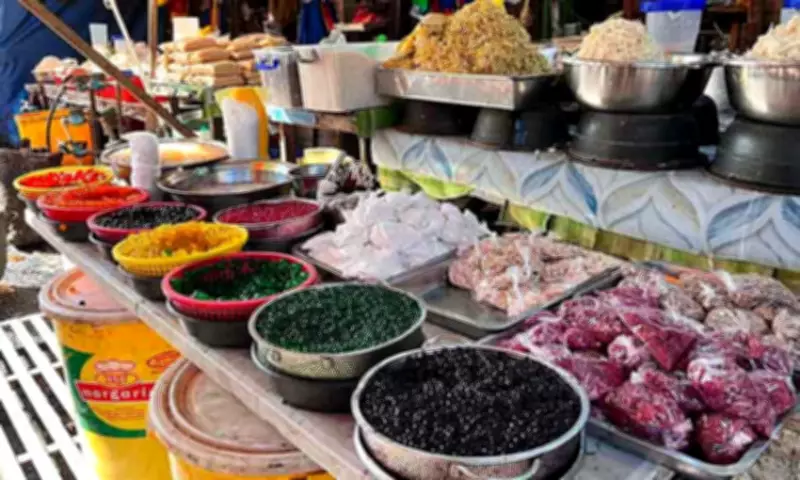
Holy Week Demand Drives Mixed Price Adjustments at Bankerohan Public Market
As of April 1, 2026, the Bankerohan Public Market is experiencing mixed price movements for key ingredients used in binignit, a traditional Filipino dessert, as demand builds ahead of Holy Week. While some items have seen significant increases, others have remained stable, reflecting the complex dynamics of seasonal demand and supply chain pressures.
Notable Price Increases for Key Ingredients
Several staple items have posted moderate to sharp price hikes. Banana varieties have shown upward trends, with saging cardava rising to ₱30 per kilo from ₱25 and saba increasing to ₱65 from ₱60. Root crops have also climbed, with kamote reaching ₱45 from ₱40 and gabi rising to ₱70 from ₱65.
The most dramatic increases have been observed in sago and langka. Sago has doubled in price, jumping to ₱120 per kilo from ₱60, with smaller servings now sold at ₱10 per cup. Langka, particularly seedless portions, has surged to ₱250 per kilo from ₱180, marking a substantial rise that vendors attribute to supplier costs and heightened demand.

Stable Prices for Select Items
Despite these increases, some ingredients have held steady in price. Landang remains at ₱90 per kilo, while vanilla flavoring continues to sell at ₱5 per pack. Lubi, or coconut, is still priced at ₱80 per kilo, with per-piece costs ranging from ₱25 to ₱30. Sugar has also remained unchanged at ₱80 per kilo and ₱40 per half kilo, providing some relief for budget-conscious shoppers.
Vendor Insights on Pricing Strategies and Challenges
Vendors report that they have begun adjusting prices in anticipation of Holy Week, when demand for binignit ingredients traditionally spikes. However, they note a shift in consumer behavior, with customers becoming more cautious and purchasing in smaller quantities rather than in bulk, likely due to tighter household budgets.
Vendor Jun-jun Sayson explained that sellers are keeping price increases minimal to avoid discouraging buyers. “We only increased it by P5 because if you raise it more, it becomes very hard to sell due to the high price. It’s not selling well—this has been on display since yesterday and is still unsold,” he said, highlighting the delicate balance between profitability and affordability.
Supply Chain Pressures and Rising Costs
On the supply side, vendors face escalating costs that contribute to retail price adjustments. Higher fuel prices have driven up transportation expenses, particularly for products sourced from Bukidnon and Calinan. These increased costs are then passed on to consumers, adding to the overall price pressure during peak seasons.
Vendor Obeta Sumaliling noted that both seasonal demand and supplier expenses are key factors. “We increased prices slightly because it’s already Holy Week, and jackfruit is also expensive from suppliers,” she said. She added that delivery fees have risen, making it more costly for vendors to maintain adequate supply levels, forcing them to adjust prices while striving to keep them accessible to customers.
Seasonal Fluctuations and Consumer Adaptation
Sellers emphasize that such price fluctuations are common during peak seasons like Holy Week, when demand rises but supply chains encounter challenges from higher costs and limited availability. Despite the upward trends, vendors observe that many consumers are adapting by buying smaller quantities, reflecting broader economic pressures and cautious spending habits.
This mixed pricing scenario at Bankerohan Public Market underscores the interplay between traditional demand cycles, supply chain dynamics, and consumer behavior, shaping the market landscape as Holy Week approaches.