Davao Region's Low-Income Households Grapple with 3.6% Inflation Spike in January 2026
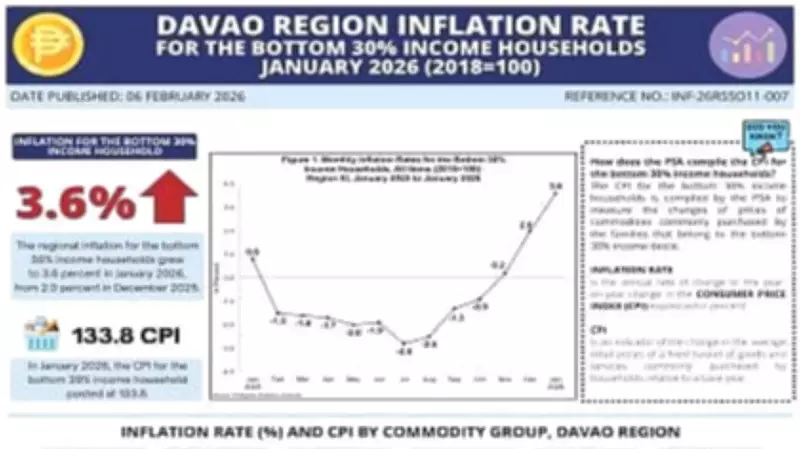
The Philippine Statistics Authority (PSA) reported on February 6, 2026, that inflation for the bottom 30 percent of income households in the Davao Region accelerated to 3.6 percent in January 2026. This marks the fastest pace in over a year, up from 2.0 percent in December 2025 and a significant increase from 0.8 percent in January 2025. The surge highlights mounting financial strain on low-income families, who allocate a large portion of their earnings to essential expenses like food, rent, and basic services.
Primary Drivers: Housing and Utility Costs Soar
According to the PSA, the uptrend in regional inflation was primarily fueled by a sharp rise in housing, water, electricity, gas, and other fuels. This category jumped to 8.5 percent inflation in January, a dramatic increase from 0.2 percent the previous month. The PSA emphasized that this faster year-on-year growth rate was the key factor behind the overall inflation increase, underscoring how basic living costs are squeezing household budgets.
Uneven Inflation Across Davao Provinces
Price pressures varied significantly across the region, with some provinces experiencing more severe impacts:

- Davao del Norte recorded the sharpest jump, with inflation surging to 5.2 percent in January from 1.6 percent in December and 0.9 percent a year earlier, reflecting rapid increases in basic household expenses.
- Davao City, the economic hub, saw inflation rise to 3.6 percent from 2.7 percent in December and 2.4 percent in January 2025, mirroring the regional average and highlighting rising urban living costs.
- Davao de Oro experienced acceleration to 3.6 percent from 0.2 percent in December, while Davao del Sur posted a slightly lower rate of 3.3 percent, easing from 3.9 percent the previous month but remaining above its 2.1 percent level a year ago.
- More moderate increases were noted in Davao Occidental, where inflation climbed to 2.5 percent from 1.1 percent, and in Davao Oriental, which slowed to 1.9 percent after reaching 2.3 percent in December. Both provinces had recorded deflation a year earlier.
Food Prices Add to Household Pressures
Food inflation contributed to the overall burden, with inflation for food and non-alcoholic beverages rising to 2.7 percent in January from 1.8 percent in December. For the bottom 30 percent income households, overall food inflation reached 2.6 percent, up from 1.7 percent. The PSA attributed this uptick mainly to higher prices of cereals and cereal products, which shifted to 1.1 percent inflation from a 3.6 percent decline a month earlier. Faster price increases were also observed for milk, dairy products, eggs, ready-made food, and other food products.
However, some food items provided limited relief, as inflation slowed or turned negative for categories such as meat, fish and seafood, oils and fats, fruits and nuts, vegetables, and sugar and confectionery, helping to temper the overall food inflation rate.
Broader Price Trends and National Context
Beyond food, prices rose faster for personal care and miscellaneous goods and services, health, restaurants and accommodation services, and recreation, sport, and culture. In contrast, transport costs fell by 0.6 percent, offering some respite for commuting households.
At the national level, inflation for the bottom 30 percent of income households increased to 1.6 percent in January from 1.1 percent in December. Among the Philippines' 18 regions, Central Visayas recorded the highest inflation at 6.1 percent, while Cagayan Valley posted the lowest at minus 0.9 percent.
Impact on Purchasing Power
The PSA noted that the Consumer Price Index for the bottom 30 percent income households in the Davao Region stood at 133.8 in January. This figure highlights how rising prices continue to erode the purchasing power of the region's poorest families, making it increasingly challenging to afford basic necessities amid economic pressures.