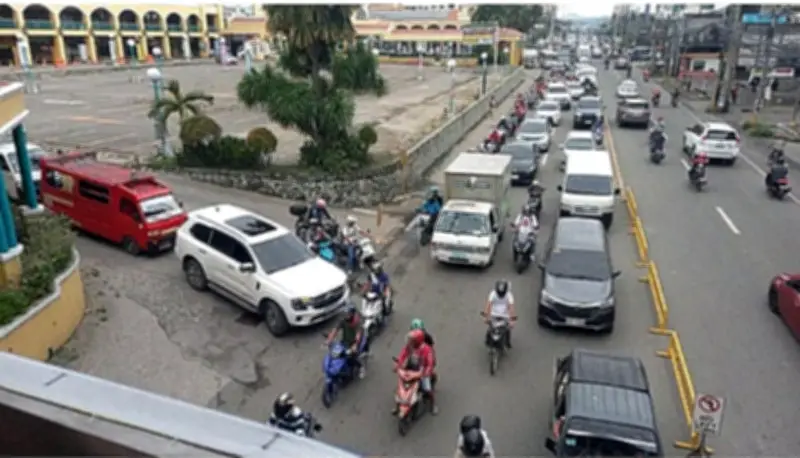
The Cebu City Transportation Office (CCTO) will begin enforcing mandatory rightmost motorcycle lanes along Gov. Cuenco Ave. in Banilad, Talamban, Pit-os and Bacayan next month as part of efforts to reduce road crashes and improve traffic flow.
Road markings will be installed starting next week, followed by an information campaign before full enforcement begins in July, according to CCTO assistant department head Kent Jongoy.
Speaking at a media forum on Tuesday, June 23, 2026, Jongoy said motorcycles will be required to stay in the rightmost lane except when making a legal left turn or U-turn.

Penalties and exemptions
Violators may be cited for disregarding traffic signs and fined P1,000. Failure to settle the fine within three days could lead to a case being filed before the prosecutor’s office, increasing the penalty to as much as P3,000.
Jongoy clarified that, unlike bicycle lanes, the motorcycle lane will not be exclusive. Four-wheeled vehicles and public utility vehicles may still use the lane when turning, entering establishments, or accessing designated lay-bys.
The measure comes as the city continues to grapple with traffic congestion and motorcycle-related crashes.
Counterflowing and enforcement
According to Jongoy, the Banilad-Talamban (Bantal) corridor records around 20 to 30 daily apprehensions for counterflowing, with about 90 percent involving motorcycles.
The proposed lane discipline ordinance, authored by Councilor Jaypee Labella and backed by the Traffic Management Coordination (TMC) Board, seeks to institutionalize designated lanes for different vehicle types, including motorcycle, and overtaking lanes.
Jongoy said the City’s traffic code, enacted in 1972, no longer reflects the rapid growth in motorcycle ownership.
Based on Land Transportation Office (LTO) data, motorcycle registrations from January to June this year have already surpassed the total recorded for the whole of last year.
He added that traffic volume has increased during peak hours, from 6 a.m. to 8 a.m. and from 4 p.m. to 7 p.m., as private schools prepare to resume classes and more motorists return to the roads.
Despite the increase, traffic conditions remain manageable on several major roads, he said.
Impact of Cebu Bus Rapid Transit
Jongoy credited the Cebu Bus Rapid Transit (CBRT) system for helping ease congestion along Osmeña Blvd. through its dedicated lanes from the Provincial Capitol to P. Del Rosario St.
He also noted improved compliance among drivers, commuters and pedestrians, particularly in observing designated stopping areas near CBRT stations.
“We have seen fewer jeepneys stopping indiscriminately and greater compliance among commuters,” he said.
Traffic hotspots
The city’s major traffic hotspots include Osmeña Blvd., the Bantal corridor, the Cebu South Coastal Road (CSCR), South Road Properties (SRP), N. Bacalso Ave. and V. Rama Ave.
Jongoy said V. Rama Ave. has become increasingly congested due to the growth of residential communities and commercial establishments in the area.
Meanwhile, CCTO data showed a significant decline in reported road crashes.
In 2025, Cebu City recorded 4,563 crashes that required official response and documentation. From January to April 15, 2026, only 120 crashes were reported.
Jongoy attributed the decrease to stricter enforcement, the deployment of deputized LTO agents within CCTO and stronger coordination with the Cebu City Police Office.
However, the SRP remains the city’s most accident-prone road.
Authorities implemented a motorcycle lane policy at the SRP in 2024 after years of fatal motorcycle crashes. While incidents have declined since then, Jongoy said motorcycle-related accidents still occur almost daily.
Of the 120 crashes recorded this year, 11 resulted in fatalities.
Anti-drunk driving drive
Cebu City is also intensifying its campaign against drunk driving following the recent donation of two breath analyzers from LTO 7.
The devices were turned over to Mayor Nestor Archival and CCTO department head Raquel Arce two weeks ago.
Jongoy said CCTO personnel are undergoing specialized training before they can legally administer breathalyzer tests.

The City hopes to eventually acquire five to 10 breath analyzers to cover its five traffic sectors — SRP, Central, North, South and East.
According to Jongoy, LTO officials file five to 10 anti-drunk driving cases weekly. In one recent operation, 12 motorists were arrested and brought to the Mabolo Police Station after failing sobriety and alcohol tests.
He also backed proposals requiring confirmatory medical examinations at government hospitals for motorists who fail breathalyzer tests to eliminate potential loopholes in enforcement.
AI-powered traffic management
The CCTO is likewise exploring the use of artificial intelligence (AI) in traffic enforcement.
Instead of relying solely on handheld speed guns, the City is studying AI-enabled cameras that can automatically detect speeding vehicles and alert nearby enforcers.
Cebu City currently has 157 signalized intersections, 47 of which already use AI-assisted digital traffic light systems that adjust signal timing based on actual traffic volume detected through CCTV cameras.
Jongoy said the City is also expanding its public CCTV traffic monitoring platform, allowing motorists to view real-time traffic conditions online.
The system is currently focused on peak-hour monitoring but may eventually be expanded to key commercial areas such as IT Park, Ayala Center Cebu and Gorordo Ave.
Despite stricter traffic policies, Jongoy said education remains central to the City’s approach.
The CCTO plans to revive its grassroots traffic education program in public schools this year to teach students and future motorists about road safety, pedestrian rights, traffic signs and responsible road use.
“We want to educate before we enforce. Traffic safety is not just the responsibility of enforcers. It requires the cooperation of all road users,” he said.