
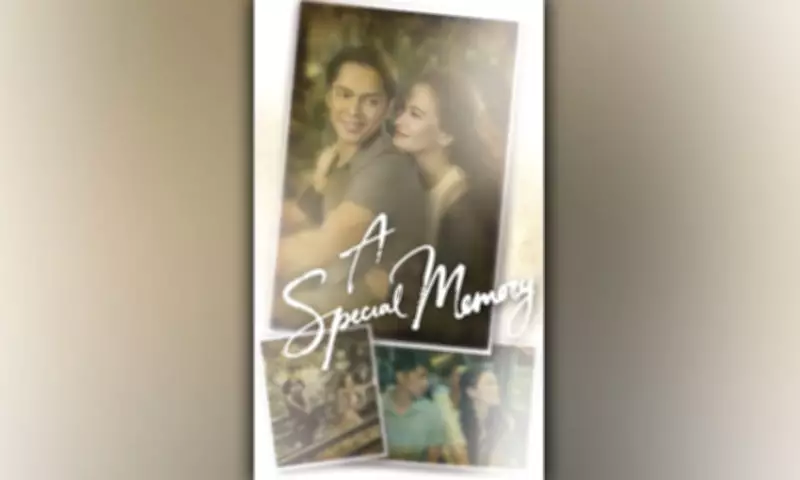
Two Shirts, Two Sentences: A Heartbreaking Premiere in Cebu
During a mall show in Cebu on February 22, 2026, a simple yet profound fashion statement captivated audiences and revealed the emotional core of an upcoming film. Actress Bela Padilla appeared wearing a shirt that read, "I'm Sandra. If found, please return to Dindo." Standing beside her, actor Carlo Aquino wore a matching shirt declaring, "I'm Dindo." These two sentences, printed on casual apparel, encapsulated the clever and sorrowful truth at the heart of their new movie, "A Special Memory," exploring the devastating impact of memory loss on love.
A Love Story Interrupted by Alzheimer's Diagnosis
Directed by Jerry Lopez Sineneng and written by National Artist Ricky Lee, "A Special Memory" is a Philippine adaptation of the acclaimed Japanese drama series "Pure Soul." Produced by Viva Films, the romance-drama premiered in cinemas on March 11, 2026. The film follows Sandra and Dindo, two individuals brought together by fate who fall deeply in love and eventually cohabitate. Their idyllic life takes a tragic turn when Sandra is diagnosed with early-onset Alzheimer's disease. Fearing she will become a burden, Sandra makes the painful decision to leave and admit herself into a nursing home, hoping to spare Dindo from witnessing her gradual decline.
The Mayo Clinic describes Alzheimer's disease as the most common cause of dementia, characterized by the accumulation of amyloid plaques and neurofibrillary tangles in the brain. Over time, these pathological changes result in the death of brain cells and significant brain shrinkage. Despite his devastation, Dindo respects Sandra's choice. He continues to visit her regularly, patiently reintroducing himself and slowly rebuilding their connection each time, even when she no longer remembers his identity.

Initial Hesitations and Emotional Preparations
Carlo Aquino shared that when he first received the script years ago, he found it emotionally overwhelming. "I understood how difficult the script was, so I initially begged off," he admitted. As he read through the material, he could already visualize himself as Dindo, which intensified the experience. "I was crying. I was already absorbing Dindo's character. I could picture it, but I was nervous." After several months of reflection, he decided to accept the role, particularly motivated by the opportunity to reunite with Bela Padilla and collaborate with director Jerry Lopez Sineneng and writer Ricky Lee.
Bela Padilla had a completely different reaction to the project. She revealed that she received an earlier version of the script three years ago, penned by a different writer. Having watched the South Korean adaptation of "Pure Soul," she recognized it as a compelling story worthy of cinematic adaptation. "For me, it was the opposite," she said. "I asked for this project." She explicitly told the producers that if there was any possibility of her being cast, she wanted to be considered for the role.
When she later read the new version of the script, she felt it required adjustments to truly honor the adaptation she admired. She inquired if the team was open to rewriting certain parts. Eventually, Ricky Lee joined the project to redevelop the material. Upon reading his version, Bela was profoundly moved. She recalled being in a salon while perusing the script. "My tears were just falling," she said. That rendition convinced her entirely, and she immediately requested to commence filming. "Ricky's script was already perfect. I even called Tita June, Viva Films vice president, and said if we can shoot this right away. The very first draft felt complete. But we had to wait for Carlo because he was finishing another film, and then I started shooting 'Isang Daang Awit Para Kay Stella,' so we just waited until our schedules finally matched," she elaborated.

Reunion and On-Set Dynamics
Since their collaboration in "Meet Me in St. Gallen" in 2018, Bela and Carlo have maintained contact, occasionally encountering each other at events and on various projects. "I think we both changed as people over the years," Bela shared. "It was exciting to see who Carlo is now and what he wanted to bring to this project." Carlo confessed that there were moments on set when he simply found himself observing Bela's performance. "There were scenes where I just wanted to watch Bela," he said. "Her delivery as Sandra—she really understood the nuances." Bela emphasized that their work was highly collaborative. Beyond their partnership, she acknowledged the significant contributions of the entire cast and crew who helped shape the film.
Approaching Complex Characters
Both actors are renowned for their emotionally driven love stories, but Bela explained that no two characters are ever identical. "There's never going to be a character that's completely the same," she said. She noted that audiences sometimes enter a cinema already anticipating a painful love narrative, but each film offers something distinct. Even actors evolve—their appearance, speech, and demeanor depend not only on personal choices but also on collaborations with stylists, makeup artists, and production designers.
"When I put on the wardrobe given to me by the stylist, my posture changes immediately. The way I deliver my lines changes," Carlo stated. A character's backstory also influences his approach to scenes. Dindo, he explained, begins the story emotionally guarded. Due to a childhood where he did not feel fully loved by his parents, he constructs emotional barriers. When Sandra attempts to get close, he struggles to lower his defenses.
"There were scenes where Carlo would enter very angry," Bela recalled. "I froze in real life." She admitted she had never seen him that angry before: "He was shaking and completely immersed in the scene." Afterwards, Carlo immediately apologized. "He kept saying sorry," Bela shared, clarifying that she wasn't hurt. She was simply astonished by the intensity of his performance. She described feeling like an audience member witnessing a powerful live performance up close.
Advocating for Local Cinema
Beyond promoting the film, Bela also spoke passionately about supporting the Philippine film industry. "To save one industry, we really have to help each other," she asserted. She encouraged audiences to continue watching films in cinemas, warning that without viewers, theaters could eventually shutter. She disclosed that the production team listened to concerns about ticket prices. For "A Special Memory," tickets will be priced lower, with certain malls offering discounts. "What's the point of setting prices at a certain level if no one is watching?" she questioned. "Film is an art form. Help us help you."