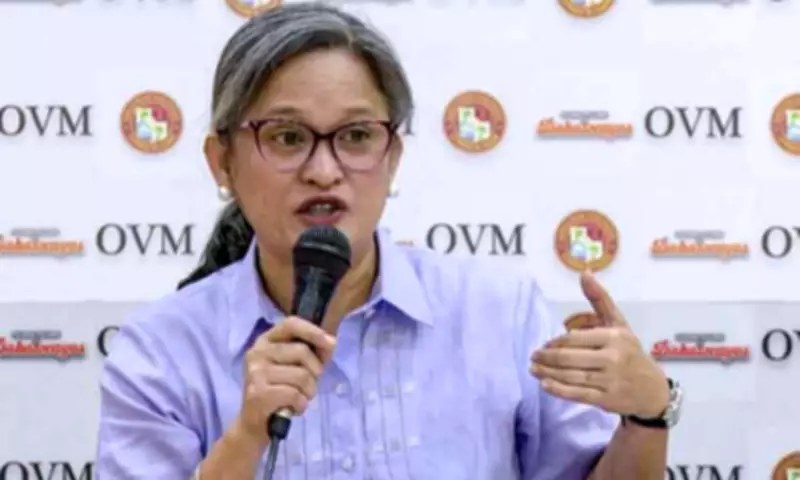
Davao City Councilor Pamela “Pameng” Librado has voiced strong opposition to the proposed construction of a Defense Fuel Support Point (DFSP) by the United States along the Davao Gulf, arguing that the facility would serve as a “war magnet” rather than a deterrent to conflict.
Privilege Speech Highlights Risks
During a privilege speech at the Sangguniang Panlungsod on April 21, 2026, Librado, who chairs the Committee on Labor and Employment Opportunities and Human Rights, said she could not remain silent on the matter. She emphasized that the local government unit must view the development within the context of global geopolitical tensions.
Librado noted that the United States is currently engaged in a conflict with Iran, driven by geopolitical interests rather than necessity. She warned that if the DFSP is constructed, it would become part of the machinery sustaining that war and extending military intervention.

“Facilities such as this are not neutral; they enable war. If we allow this, we risk turning the Philippines into a proxy staging ground for foreign conflicts,” she said.
DFSP as a Target
The councilor argued that while proponents claim the DFSP will enhance national defense by acting as a deterrent, the reality is that a fuel depot makes the Philippines a magnet for conflict. She pointed out that if Davao City becomes a target, ordinary citizens would be the first to suffer.
Librado stressed that the DFSP is not merely about defense cooperation; it draws the Philippines into conflicts that do not involve it. Allowing the facility to operate would make the nation a logistical base for foreign military intervention, turning it into a silent partner in wars that displace communities, destroy livelihoods, and violate human rights.
Call for Neutrality
Librado urged the Philippine government to reject any role as an extension of foreign military power. She emphasized that even if the country is not directly involved in US-led wars, hosting a refueling hub could still make it a target. She cited examples of Qatar, the United Arab Emirates, Iraq, and Kuwait, which have become targets due to hosting US military bases.
The proposed DFSP is anchored in agreements such as the Enhanced Defense Cooperation Agreement (EDCA), the Mutual Defense Treaty (MDT), and the Visiting Forces Agreement (VFA). Librado described the proposal as insensitive, given the Philippines is currently facing an energy crisis amid rising global oil prices caused by the Middle East conflict.
Constitutional Concerns
Librado raised constitutional issues, citing Article II, Section 7 of the 1987 Constitution, which mandates an independent foreign policy prioritizing sovereignty and national interest. She argued that enabling foreign war logistics runs counter to this principle.
“Our land must serve the Filipino people, not foreign military interests,” she said. She called for a policy of neutrality and independence, opposing the hosting of any foreign military bases.
Librado proposed that the city council pass a resolution expressing collective opposition to the DFSP and rejecting the move to make the Philippines a proxy for foreign wars. She moved for her privilege speech to be considered as a first reading.
Broader Opposition
The progressive group Bagong Alyansang Makabayan-Southern Mindanao had earlier urged local governments in Davao City, Davao del Sur, and nearby provinces to reject the DFSP. The City Government of Davao subsequently stated it would not support any plan to build a foreign military facility within its jurisdiction, citing economic concerns.
The proposed facility is part of a network of refueling hubs planned across the Western Pacific, including sites in Australia and Papua New Guinea, to support US military operations. The US Defense Logistics Agency issued a solicitation for contractors on March 31, 2026, to bid for the project, which would store 977,000 barrels of fuel for US warships and aircraft over four years.