
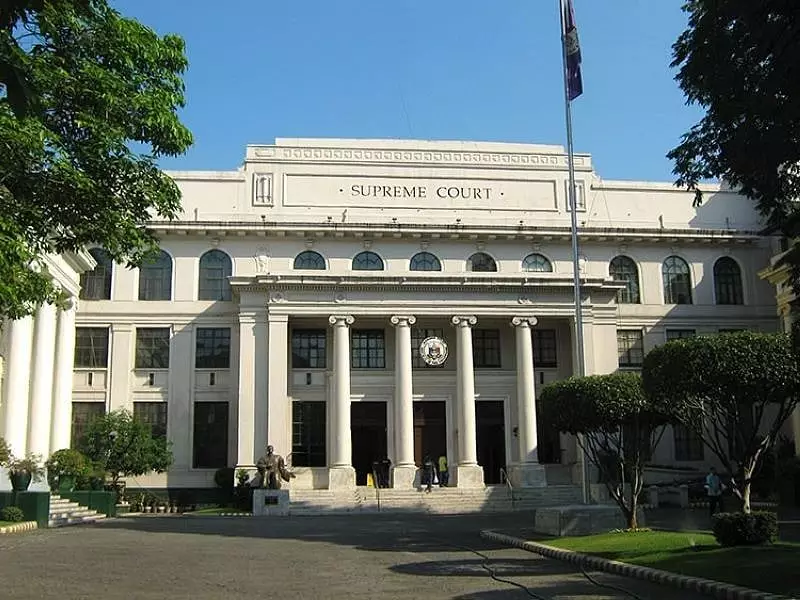
The Supreme Court of the Philippines has taken the unprecedented and severe step of stripping a sitting judge of his title and permanently revoking his license to practice law for orchestrating the assassination of a fellow judge.
The Judicial Murder Plot
In a landmark ruling, the SC En Banc ordered the immediate dismissal and disbarment of Oscar D. Tomarong, the presiding judge of the Regional Trial Court (RTC) Branch 28 in Liloy, Zamboanga del Norte. This decisive action stems from disciplinary proceedings related to the murder of Judge Reymar L. Lacaya of RTC Branch 11 in nearby Sindangan, Zamboanga del Norte.
The crime traces back to 2019, following a reassignment that saw Tomarong and Lacaya swap court branches. Tragically, Lacaya was killed shortly after this exchange. Court records detail that he was shot and killed in the afternoon after a hearing at Branch 28. Witnesses reported hearing gunshots as he walked to his car behind the court building, where his body was later found.

The crucial link to Judge Tomarong was provided by Juliber Cabating, a public works employee who also served as the judge's errand aide. Cabating testified that Tomarong directly instructed him to hire contract killers to eliminate Lacaya. According to the testimony, Tomarong funneled P250,000 through Cabating to the hitmen to carry out the execution. Cabating stated that Tomarong expressed he had "reached his limit" and could no longer tolerate an unspecified "excessive" situation.
Why the Supreme Court Acted Before the Criminal Appeal
A significant aspect of this case is the High Court's decision to impose administrative penalties despite Tomarong's criminal conviction for murder in 2024 still being under appeal. The SC clarified that it is not required to wait for a final criminal conviction in disciplinary cases.
The standard in administrative proceedings is "substantial evidence"—proof that is reasonable to establish the offense occurred. The Court found that the evidence against Tomarong met this threshold, allowing it to proceed with his dismissal and disbarment independently of the pending criminal appeal.
Moral Turpitude and the End of a Legal Career
The Supreme Court classified the murder as a crime involving "moral turpitude," defined as conduct contrary to justice, honesty, or good morals. The ruling emphasized that murder represents one of the gravest possible violations of a judge's duty to society.
The decision underscored the profound severity of a judge committing such a crime against a peer, particularly in an environment where judicial safety is a growing concern. "At a time when the rise in the attacks against judges has even necessitated the adoption of measures to protect judges, a judge committing the murder of a fellow judge must be punished swiftly and severely," the ruling stated.
The consequences for Tomarong are career-ending and far-reaching:
- Immediate dismissal from government service.
- Forfeiture of all retirement benefits.
- Disbarment, striking his name from the Roll of Attorneys.
- Permanent ban from practicing law.
- Lifetime disqualification from reemployment in any government office.
The Court declared that a lawyer who demonstrates an "utter disregard for the sanctity of human life" is fundamentally unfit to remain in the legal profession. This ruling also serves as a directive for all courts to promptly report convictions of court personnel to the Judicial Integrity Board.