Minglanilla in Critical Governance Phase After Ombudsman Suspends Entire Local Government
The City of Minglanilla now finds itself at a critical juncture following the suspension of Mayor Rajiv Enad, Vice Mayor Elanito Peña, and the entire municipal council for a period of one year. This unprecedented administrative action has plunged the local government into a state of uncertainty, raising significant questions about leadership continuity and public service delivery in this rapidly developing area.
Suspension Order and Immediate Succession Measures
The suspension order, originating from the Office of the Ombudsman, was formally received by the affected officials on Monday, February 2, 2026. In response to this governance vacuum, immediate succession measures were implemented to prevent paralysis of municipal services. First Councilor Lheslen Enad, who is the wife of suspended Mayor Rajiv, has been designated as the acting mayor, while Councilor Mulot Laput assumes the role of acting vice mayor.
Provincial Director Jesus Sastrillo Jr., the head of the Department of the Interior and Local Government (DILG) Cebu Province, confirmed these appointments on Tuesday, February 3, 2026. Director Sastrillo emphasized that these temporary designations were necessary to ensure uninterrupted delivery of essential services to Minglanilla residents during this challenging transition period.

Root Causes: Landslide Risk Management in Sityo Napo
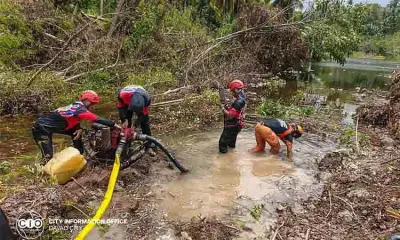
The suspension stems from the local government's alleged handling of landslide risks in Sityo Napo, Barangay Guindarohan. The legal case originated from environmental concerns that emerged in late 2022, when the Mines and Geosciences Bureau (MGB) Region 7 detected significant ground movement in the area during November of that year.
Geological experts issued warnings that the soil composition in Sityo Napo, characterized by clay mixtures with high susceptibility to liquefaction and erosion, presented elevated landslide risks during periods of heavy rainfall. In response to these identified ground fissures, the local government mandated the evacuation of families to safer locations and suspended quarrying activities near the affected area to prevent further soil destabilization.
Despite these precautionary measures, Mayor Enad maintained that his administration's decisions were made with community safety as the paramount concern. He defended the actions taken by his administration as necessary precautions against potential environmental disasters that could threaten residents' lives and properties.
Leadership Challenges in a Rapidly Developing Municipality
The assumption of leadership by Acting Mayor Lheslen Enad presents a substantial test for her administrative capabilities, particularly in a municipality experiencing accelerated development that increasingly resembles urban characteristics. The fundamental question emerges: Can the acting mayor effectively steer a locality that, in terms of geographical size, population density, and economic progress, already functions much like a city?
Managing a municipality with urban-scale complexities becomes particularly challenging when the entire legislative council remains vacant, awaiting formal designation orders from national authorities. This situation creates a significant governance gap that could hinder responsive decision-making and legislative action.
Legislative Vacuum and Political Implications
Currently, all council positions remain vacant, creating what observers describe as a substantial legislative void. Regardless of the acting mayor's administrative competence, the executive branch requires legislative support for urgent resolutions and ordinances that address community needs and municipal development priorities.
The responsibility for selecting replacement council members now falls to the Nacionalista Party (NP), the political affiliation of both Mayor Enad and the suspended council members. This situation places considerable pressure on the party to identify qualified individuals who can provide stable governance during this transitional period while maintaining public trust in local institutions.

While Provincial Director Sastrillo has assured residents that the succession plan aims to prevent service disruption, the reality of operating without a functioning legislative body presents undeniable challenges for effective governance. The coming months will test the resilience of Minglanilla's administrative structures and the adaptability of its temporary leadership in maintaining municipal operations amidst this unprecedented suspension scenario.