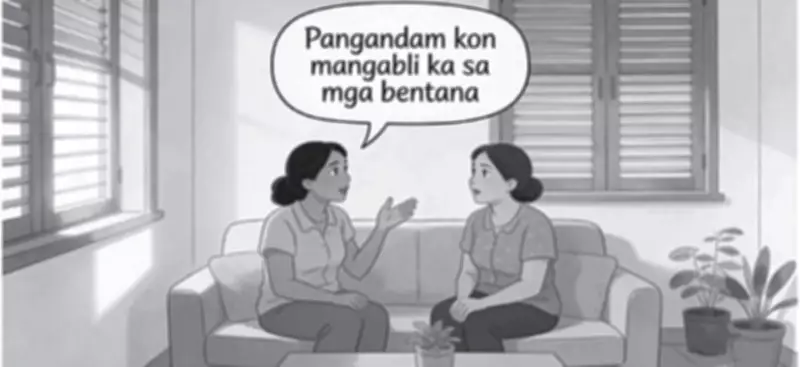
This article continues from the previous release on April 26, 2026, regarding the use of affixes in the Cebuano language.
Second Rule of Mang-
Mang- is used with roots that begin with a vowel without a hyphen; the spelling does not change.
Examples:

- mang+alsa → mangalsa
- mang+abot → mangabot
- mang+ilis → mangilis
- mang+ilad → mangilad
- mang+utang → mangutang
- mang+uli → manguli
- mang+eskwela → mangeskwela
- mang+imbitar → mangimbitar
Third Rule of Mang-
If the root begins with /l/, the root does not change.
Examples:
- mang+limpyo → manglimpyo
- mang+lampaso → manglampaso
- mang+laba → manglaba
Using Pang-
If the root begins with /k/, the /k/ is removed.
Examples:
- pang+kalut → pangalut / pangawut (digging)
- pang+kubkub → pangubkub (repeated digging)
Additional Rule
If the root begins with a vowel or the letters a, i, u, g, and l, the root does not change and is directly attached.
Examples:
- pang+andam → pangandam (preparation)
- pang+abli → pangabli (opening)
- pang+ibog → pangibog (attraction/desire)
- pang+uli → panguli (going home)
- pang+hatag → panghatag (giving)
- pang+higot → panghigot (tying)
Using Pang- vs. Pam-
The correct form is pang-, not pam-, which is influenced by Tagalog.
Examples:
- pangbunal (not pambunal)
- pangpuspos (not pampuspos)
Old Affixes (Mahag-, Ikag-, Nakag-)
These are no longer used in modern writing due to changes in usage and the preference for smoother pronunciation (euphony).
Examples:
- mahasulod (not mahagsulod)
- ikatug-an (not ikag-tug-an)
- nakatulog (not nakagtulog)
Using -han
Attached to verbs ending in a vowel without a glottal stop; the pronunciation is stressed and usually related to a directed object.
Examples:
- gasahan (giving a gift upon arrival)
- giyahan (guiding)
Using -hon
Attached to verbs ending in a vowel with a glottal stop; the pronunciation is stressed due to /h/.
Examples:
- kulatahon (to beat)
- bagahon (to turn into charcoal/ember)
Affixes with Loanwords
Affixes are not italicized and are attached using a hyphen; the original spelling is retained.
Examples:
- mi-decide
- mi-exam
- mi-exit
- ning-dive
- ning-jam
- gi-karnap
Second Rule for Loanwords
Based on the revised Filipino orthography: spelling follows pronunciation.
Examples:
- anderlaynan (underline)
- sirkulan (encircle)
Additional Rule
If the loanword is fully adopted, write it in Cebuano.
Examples:
- taxi → magtaksi
- mag-taxi or magtaksi
- mag-jeep or magdyip
These rules are influenced by common usage in Cebuano. The reasons include:
- Principle of euphony (pleasant arrangement of words with beautiful sound in pronunciation)
- Continuous language change
- Adoption of patterns from other languages by speakers
In the study by Tan (1967), sentence structures were analyzed to identify reasons why Cebuano youth struggle to learn Filipino.