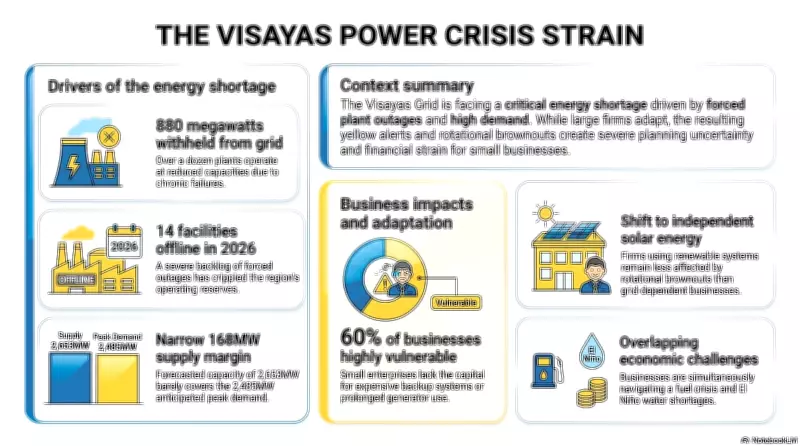
The Visayas grid is experiencing persistent power reserve shortages, challenging the resilience of local businesses and exposing structural vulnerabilities in the regional energy infrastructure. Companies are navigating overlapping economic difficulties as the grid frequently enters yellow alert status due to insufficient operating reserves.
Root Causes of the Power Shortage
The National Grid Corp. of the Philippines (NGCP) issues yellow alerts when operating margins fall below required contingency reserves, signaling an elevated risk of rotational brownouts. Projected available capacity often barely meets peak demand, such as a recent forecast of 2,653 megawatts (MW) against an anticipated peak of 2,485 MW. The primary cause is a severe backlog of forced outages and reduced capacities across numerous power plants. In May 2026 alone, 14 facilities went offline, joining a chronic list of failures dating back to 2021. Additionally, over a dozen plants operate at derated capacities, withholding more than 880 MW from the grid. Key contributors include Thermal Visayas Inc. Units 1 and 2 in Cebu and Panay Energy Development Corp. (PEDC) Unit 3 in Panay. High electricity demand compounds the strain on this crippled system.
Immediate Impact on Businesses
The Cebu Chamber of Commerce and Industry considers the immediate impact of rotational brownouts manageable, as most interruptions last roughly an hour. Factories and commercial establishments can maintain operations through temporary schedule adjustments and localized contingency plans. However, the deeper concern is the total uncertainty surrounding the crisis duration. Companies rely on long-term projections, and recurring utility instability forces frequent strategy recalibrations, making accurate planning exceptionally difficult for industries dependent on continuous electricity supply.

Disproportionate Effect on MSMEs
Micro, small, and medium enterprises (MSMEs) are disproportionately threatened. They constitute approximately 60 percent of the chamber’s nearly 900 members. Unlike large corporations, MSMEs lack the financial capital to invest in large backup systems or sustain prolonged generator operations, leaving them highly vulnerable to unexpected energy costs and operational disruptions.
Broader Economic Context
The power crisis overlaps with other economic challenges, including a fuel crisis and the impending El Niño phenomenon, which threatens water availability. This convergence complicates corporate survival and tests business adaptability. Some large establishments have begun investing in independent solar energy systems and backup generators. Firms using existing renewable energy systems are far less affected by rotational brownouts than those fully dependent on the main grid. Clear and straightforward communication regarding grid stability remains essential to prevent widespread commercial panic.
Future Outlook
The critical factor moving forward is how effectively national and local governments deliver support to the business sector. The community is closely watching whether authorities will implement robust, long-term measures to stabilize the Visayas power supply rather than relying on temporary fixes. Another vital element is the progress of ongoing repairs at major unavailable power plants, particularly the TVI units in Cebu and the PEDC unit. Successful restoration of these key assets to full capacity in the coming months will determine whether the Visayas grid can rebuild its contingency reserves and avert wider, more economically damaging blackouts across the region.