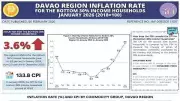
Davao Low-Income Inflation Hits 3.6% in Jan 2026
Inflation for bottom 30% income households in Davao Region rose to 3.6% in January 2026, driven by housing and utility costs, with uneven impacts across provinces.


Inflation for bottom 30% income households in Davao Region rose to 3.6% in January 2026, driven by housing and utility costs, with uneven impacts across provinces.

Philippine Statistics Authority reports Davao Region's inflation rose in December 2019 due to fish price spikes. In January 2026, national food inflation slowed to 0.7%, though non-food inflation increased, with government measures targeting energy costs.

The Philippine Competition Commission convened global experts for the Manila Forum on Competition in Developing Countries, focusing on institutionalizing enforcement for digital economy challenges and inclusive growth.

Central Visayas recorded the highest inflation rate in the Philippines at 5.6% in January 2026, driven by sharp rises in restaurants and accommodation services. National inflation edged up to 2%, with food prices easing but housing costs accelerating.

Shared lists with real-time sync. No signup needed — just open and shop together.
Recommended
A new study predicts the Philippine economy will grow by 5% in 2026, supported by early budget allocations to LGUs and manageable inflation, aiming to exceed government targets.

The Pampanga Chamber of Commerce urges national government to restore public trust and improve efficiency after 2025 GDP growth fell to 4.7%, citing infrastructure delays and corruption concerns.

The Bangko Sentral ng Pilipinas identifies rising costs of rice, fish, fuel, and peso depreciation as key inflation risks for January 2026, despite some offsetting factors like lower electricity rates.

Palace Press Officer Claire Castro emphasizes the administration's seriousness in addressing corruption in flood control projects, highlighting its importance for restoring business confidence and public trust.

Chicken prices in Davao City have normalized after December spikes, with Bankerohan Public Market offering the most affordable options. While poultry costs ease, vegetable prices rise due to hot weather affecting supply.
Shared lists with real-time sync. No signup needed — just open and shop together.
Recommended
The Philippines' Producer Price Index for manufacturing grew 0.9% year-on-year in December 2025, driven by electronics, metals, and transport equipment, while food manufacturing prices declined slightly.

PSA Davao Oriental reports a 2.1% inflation rate in December 2025, driven by earthquake-induced panic buying and price increases in food, housing, and personal care items.

The Philippine economy grew 4.4% in 2025, below government targets, but officials plan to leverage the 2026 ASEAN chairship to boost tourism and business through improved coordination and digital services.

The Philippine Economic Zone Authority has greenlit 18 new projects worth P12.86 billion, expected to create over 1,000 jobs and generate $59.74 million in exports, with a focus on manufacturing, IT-BPM, and tourism.

The Philippine economy expanded by 4.4% in full-year 2025, falling short of the government's 5.5-6.5% target. Key drivers included services and trade, while industry contracted. Officials cite climate disruptions and corruption as factors affecting growth
Shared lists with real-time sync. No signup needed — just open and shop together.
Recommended
Malacañang asserts the Philippine economy is moving in the right direction under President Marcos Jr., citing falling unemployment, poverty reduction, and manageable inflation as key achievements.

Malacañang acknowledges that investigations into flood control projects and recent natural disasters could hinder this year's GDP growth target, while emphasizing continued economic stimulus efforts.

Moody's Analytics reports Philippine Q4 2025 GDP growth at 5.3%, driven by electronics exports, with full-year 2025 at 5.1% below government targets.

An economist reveals the Philippines is awash in liquidity from remittances, BPO revenues, and tourism, but weak public investment is hindering economic growth potential.

President Ferdinand Marcos Jr. rejects a P60 to $1 exchange rate, with the Palace warning of negative effects on national debt. He met with BSP officials to discuss the peso's value.
Shared lists with real-time sync. No signup needed — just open and shop together.
Recommended
The Bangsamoro Board of Investments has approved ₱1.6 billion in projects, including agricultural development in Maguindanao del Norte and water facilities in Cotabato City, creating 750 jobs.

The US economy grew at an annualized 4.4% in Q3 2025, revised up from 4.3%, driven by strong investment and exports. Inflation remains stable, but experts warn of uneven benefits and a jobless boom.

Maybank economist forecasts stable domestic consumption in the Philippines for 2026, driven by robust OFW remittances and BPO sector growth, supporting economic expansion amid global uncertainties.

China's economy grew 5% in 2025, hitting its target with a GDP of $20 trillion. Discover the details of its Q4 performance and what this means for global markets.

Finance Secretary Frederick D. Go outlines major reforms in trade, transport, and automotive sectors to sustain Philippine economic momentum. Discover the government's strategic moves to boost investor confidence.
Shared lists with real-time sync. No signup needed — just open and shop together.
Recommended
Philippine economic officials rallied over 300 business leaders to push for big bold reforms, aiming to strengthen governance, boost investor confidence, and drive sustainable growth. Read the full story.
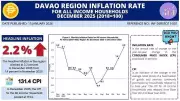
Inflation for Davao Region's poorest 30% of households accelerated to 2.0% in December 2025, driven by rising food costs. Learn how this impacts family budgets and where prices are climbing fastest.
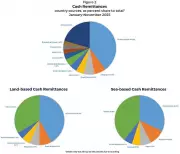
Cash sent home by overseas Filipinos rose to $2.91 billion in November 2025, boosting household spending and the Philippine economy. Read the full report.

Cebu's economy is booming with infrastructure and BPO growth, but faces challenges in traffic, waste, and power. Discover the island's path forward.

Philippine inflation ended 2025 at 1.7%, below the 2-4% target. Government measures shielded households, though Typhoon Uwan pushed December's rate to 1.8%. Read the full report.
Shared lists with real-time sync. No signup needed — just open and shop together.
Recommended
RDC-11 greenlights Davao's 2023-2028 Midterm Development Plan, targeting an international logistics hub with P268.9B in projects. Discover the recalibrated strategies for growth.
