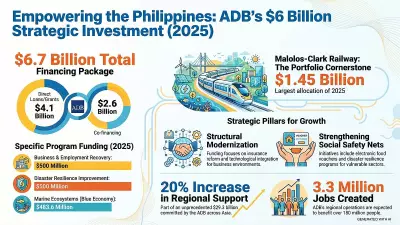

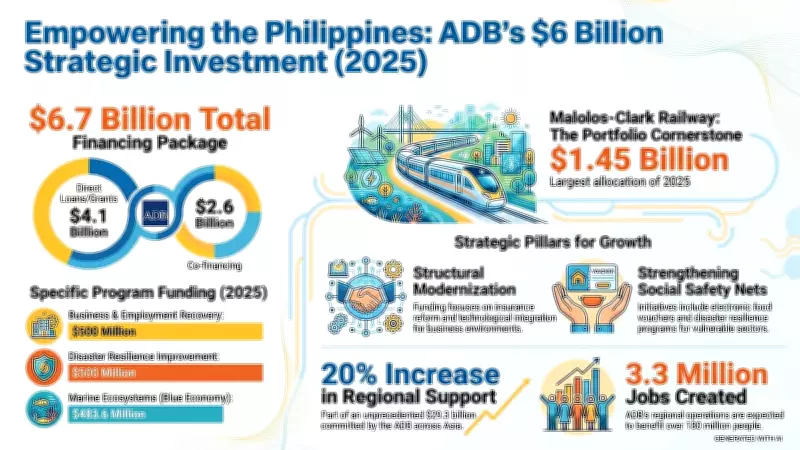
The Philippines secured more than US$6 billion in financing and co-financing packages from the Asian Development Bank (ADB) last year, according to the ADB's Annual Report 2025 released on Thursday, April 23, 2026.
Loans and Grants Breakdown
The report showed that the bank released $4.1 billion in loans and grants to the country in 2025. Of this total, $1.45 billion was allocated for the Malolos-Clark Railway-Tranche 2; $500 million for the Business and Employment Recovery Program (Subprogram 2); $381.5 million for the Insurance Reform Program (Subprogram 1); and $500 million for the Second Disaster Resilience Improvement Program.
The ADB also provided $400 million for the Reducing Food Insecurity and Undernutrition with Electronic Vouchers; $483.6 million for the Marine Ecosystems for Blue Economy Development Program (Subprogram 1); and $388.9 million for the Business Environment Strengthening with Technology Program (Subprogram 1).

Infrastructure and Recovery
Beyond direct loans, the Philippines received $2.6 billion in co-financing from the ADB. For the whole Asia and the Pacific region, the bank committed $29.3 billion from its own resources in 2025 while advancing key institutional reforms.
“In 2025, ADB delivered unprecedented levels of support, with a 20 percent increase over 2024 and expected impacts of more than 3.3 million jobs and benefit to over 180 million people,” ADB President Masato Kanda said.
Regional Development Scale
Kanda noted that the figures demonstrate the bank’s ability to deliver at a scale and speed that matches the demands of Asia and the Pacific. The report highlights a significant expansion in operations aimed at addressing regional economic vulnerabilities.
Strategic Project Funding
The Malolos-Clark Railway project remains a cornerstone of the Philippine portfolio, receiving the largest single chunk of the 2025 allocation. Other programs focused on insurance reform and technological integration for business environments reflect a shift toward structural modernization.
Disaster and Food Security
Significant portions of the funding were also directed toward social safety nets and resilience. The disaster improvement program and the electronic voucher initiative for food security aim to protect vulnerable sectors from external economic shocks and natural calamities.