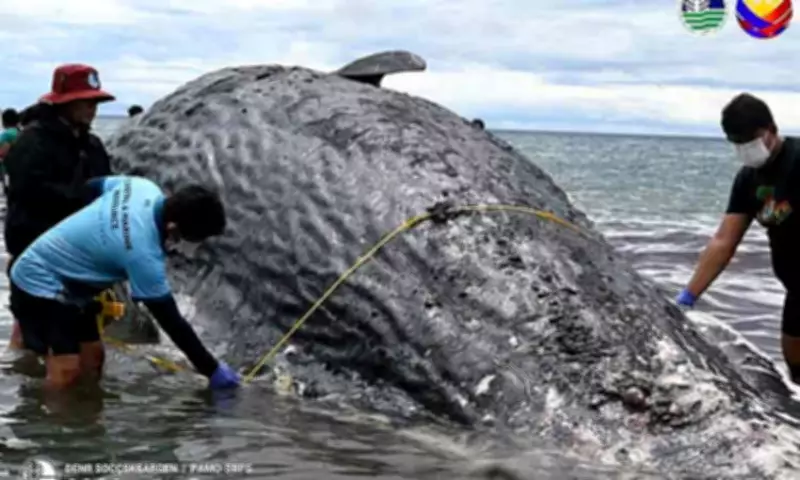
Dead Sperm Whale Discovered in Sarangani Bay Waters
On February 22, 2026, a significant marine discovery occurred when a 12.3-meter female sperm whale was found dead and floating near Barangay Taluya in Glan, Sarangani Province. The Department of Environment and Natural Resources-Soccskargen (DENR-Soccskargen) reported that the carcass was classified as Code 3, indicating moderate decomposition, which suggests the animal had been deceased for several days before being sighted offshore.
Scientific Investigation and Response Protocol
The discovery triggered an immediate coordinated response involving multiple agencies. The Protected Area Management Office of the Sarangani Bay Protected Seascape led efforts that included participation from local government units, the Bureau of Fisheries and Aquatic Resources, the Philippine Coast Guard, and the Philippine National Police Maritime Group.
Marine specialists conducted comprehensive field examinations following established scientific protocols. These procedures included:

- Detailed morphometric measurements
- Thorough external assessment of the carcass
- Tissue sampling for laboratory analysis
Authorities subsequently towed the whale carcass to the shoreline of Barangay Tango for safe access, documentation, and eventual burial. The burial site coordinates were meticulously recorded to allow potential future exhumation should additional scientific study become necessary.
Ecological Significance and Regional Connections
Initial scientific findings suggest the whale may have originated from the Sulu–Sulawesi Marine Ecoregion, recognized globally as one of the most biologically diverse marine regions on Earth. This vast oceanic corridor connects the Philippines, Indonesia, and Malaysia, serving as a global hotspot for coral reef diversity and migratory marine species.
Oceanographers explain that strong regional currents, seasonal monsoon flows, and deep-water circulation patterns can transport floating objects—including marine mammal carcasses—across substantial distances, sometimes carrying them far from their original locations.
The presence of such a large oceanic species in Sarangani Bay waters underscores the bay's ecological importance. Located at Mindanao's southern tip and opening into the Celebes Sea, Sarangani Bay features:
- A deep basin with steep underwater slopes
- Nutrient-rich waters supporting plankton blooms
- Extensive reef systems and migratory fish populations
Marine researchers consider this area an important ecological transition zone where coastal and pelagic ecosystems intersect, capable of supporting both reef-dwelling species and large deep-sea animals passing through offshore routes.
Scientific Value and Conservation Implications
Sperm whales typically inhabit deep offshore environments, diving thousands of meters in search of squid and other prey. Their extensive migratory range, which can span entire ocean basins, means shoreline strandings provide rare opportunities for researchers to collect biological data otherwise difficult to obtain.
Environmental authorities emphasized the scientific value of collected samples, which will undergo examination to determine:
- Health status and possible disease presence
- Exposure to pollutants and chemical contamination
- Evidence of physical trauma or injury
- Indicators of plastic ingestion or other threats
Such analyses contribute to long-term monitoring of marine mammal populations and can reveal emerging threats linked to ocean warming, prey distribution changes, or other environmental shifts.
"Sperm whales are the largest toothed whales in the world and typically inhabit deep offshore waters, migrating across large marine regions. The incident highlights the transboundary nature of marine wildlife and the need for broader conservation efforts beyond local waters," stated DENR-Soccskargen officials.
Broader Conservation Context
The agency further noted that this case demonstrates how marine conservation cannot be confined within political boundaries. Because ocean ecosystems are fundamentally interconnected, protecting migratory species requires cooperation among neighboring countries sharing the same seas.

Regional frameworks and joint monitoring programs are considered essential for safeguarding marine biodiversity across connected waters such as the Sulu–Sulawesi corridor and southern Philippine seas. The stranding also underscores the importance of rapid reporting by coastal communities, as a Bantay Dagat volunteer's alert enabled authorities to quickly secure the site, collect scientific evidence, and prevent potential public health risks from decomposition.
Environmental managers emphasized that timely responses improve biological sample quality, which in turn strengthens research data used for conservation planning. Marine scientists note that each stranding event, while unfortunate, offers valuable insights into ocean conditions otherwise difficult to study.
Large marine mammals function as important indicators of ecosystem health, meaning unusual deaths or strandings can signal broader environmental shifts including prey scarcity, underwater noise disturbance, or climate-driven habitat changes. This incident serves as both a scientific opportunity and a reminder of the interconnected challenges facing marine conservation in the Indo-Pacific region.