
DENR Secretary Demonstrates Water Safety in Remote Island Inspection
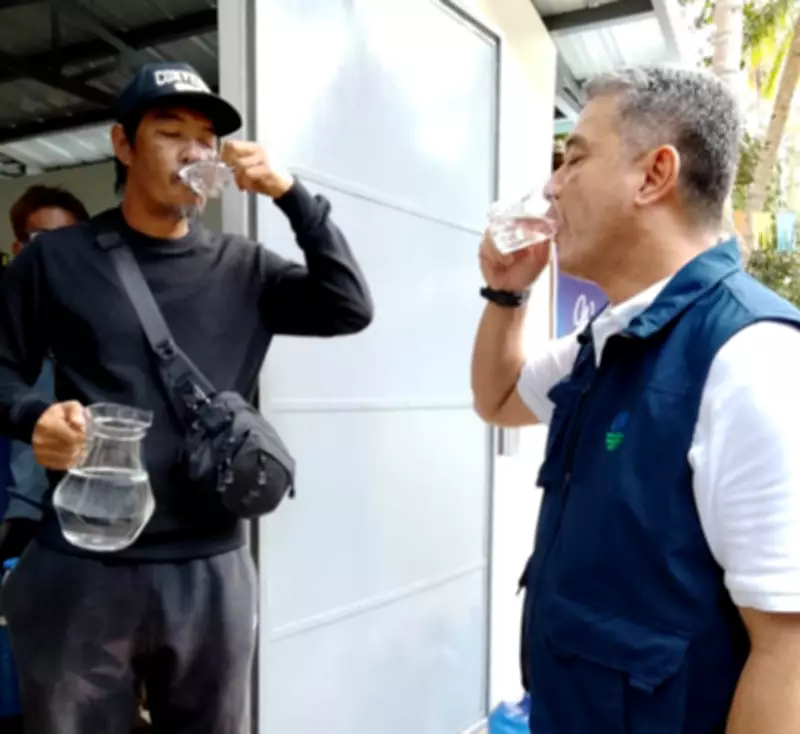
Department of Environment and Natural Resources (DENR) Secretary Juan Miguel Cuna conducted a significant inspection on Tuesday, March 31, 2026, at the water filtration and desalination project in Tumalutab, a remote island located off the coast of Zamboanga City. In a powerful demonstration of the project's success, Secretary Cuna and Tumalutab Village Chairperson Joemer Abunawas drank water from the newly installed system to prove its safety and potability.
Project Details and National Roadmap
The Tumalutab Island project, situated approximately 20 kilometers from mainland Zamboanga City, serves as a primary beneficiary of the DENR's Water Filtration Program. Secretary Cuna emphasized that this initiative is a crucial component of a larger P485 million roadmap developed by the DENR's Water Resources Management Office (WRMO). This comprehensive strategy aims to address critical water supply gaps in water-stressed, geographically isolated, and disadvantaged areas across the Philippines.
During an interview at the project site, Cuna revealed that the Tumalutab installation required an investment of approximately P2 million to P3 million. He further explained that Tumalutab was selected as one of six small island barangays for the initial phase of the DENR's Water Filtration Program, highlighting its strategic importance in the national effort.

Infrastructure and Economic Impact
The DENR, through the WRMO, successfully completed the installation of a desalination filtration system and its corresponding housing structure in December 2025. This completion has led to a substantial economic benefit for local residents. Previously, residents typically paid between P50 to P70 per five-gallon container of water. With the new system in place, this cost has been significantly reduced to P20 to P25 per container.
However, due to recent increases in fuel prices, the current cost has adjusted to P30 per five-gallon container. The fees collected from water sales within the village are specifically allocated for the ongoing maintenance and operation of the water system, ensuring its sustainability and long-term functionality.
Community Benefits and Health Improvements
Tumalutab Village Chairperson Joemer Abunawas expressed profound gratitude for the project, noting its substantial help to residents, particularly in terms of health and sanitation. Abunawas explained that prior to the project, children and some adults frequently complained of stomach aches, as their primary water source was deep wells, which often contained contaminants.
In a separate interview conducted in the local vernacular, Abunawas stated, "We are thankful with the government for choosing this island, through the DENR, to be a beneficiary of the water filtration program." The project has directly benefited 3,436 residents, whose livelihoods primarily depend on informal labor, fishing, and coastal trade, thereby enhancing their quality of life and economic stability.
Future Expansion and National Reach
Looking ahead, Secretary Cuna announced ambitious plans for the program's expansion. He confirmed that an additional 26 island and remote villages are slated to benefit from the DENR's Water Filtration Program before the end of 2026. This expansion underscores the government's commitment to addressing water accessibility issues in the most isolated regions of the country, promoting public health, and supporting sustainable community development through innovative water management solutions.