Philippine Air Force Stresses Routine Nature of Joint Drills with US Amid Regional Tensions
The Philippine Air Force (PAF) has categorically stated that a series of recent bilateral air exercises conducted with United States military assets over Luzon and the West Philippine Sea are not a reaction to the ongoing tensions between China and Taiwan. According to PAF spokesperson Col. Ma. Christina Basco, these drills are purely pre-approved training activities aimed at enhancing operational readiness and interoperability between the two allied forces.
Pre-Scheduled Exercises Under Mutual Defense Framework
Col. Basco clarified that the air exercises, which took place from February 2 to 6, 2026, were scheduled well in advance and conducted under the framework of the Mutual Defense Board and Security Engagement Board (MDB-SEB) between the Philippines and the United States. She emphasized that such joint training is a regular occurrence between the PAF and the U.S. Pacific Air Forces (PACAF), designed to exercise operational readiness and strengthen bilateral cooperation.
"It is scheduled and it is conducted with our partners so that we can exercise operational readiness and interoperability. And it's a usual exercise of the PAF with the PACAF," Basco told reporters, dismissing any connection to the China-Taiwan row.

Details of the Bilateral Air Patrol and Exercises
The bilateral engagement featured a coordinated series of air activities across multiple locations in Luzon, including Col. Ernesto Rabina Air Base in Tarlac City and areas over the West Philippine Sea via the Luzon Strait. Key components of the exercises included:
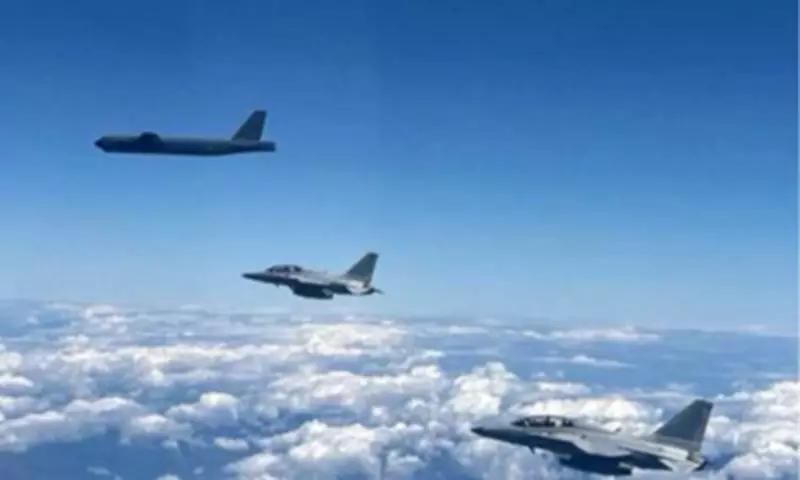
- A live drop exercise on February 2, involving two PAF FA-50PH fighter aircraft and two U.S. PACAF B-52 bomber aircraft.
- An air defense scenario on February 4 over the West Philippine Sea, focusing on airspace coordination, command-and-control integration, and joint operational response.
- A joint bomber air patrol on February 6 over the West Philippine Sea and Luzon Strait, highlighting combined mission planning, airspace coordination, and operational readiness among PAF, PACAF, and supporting U.S. forces such as the U.S. Special Operations Command Pacific and Marine Corps Forces, Pacific.
Basco noted that escorting foreign aircraft entering Philippine airspace is standard protocol, explaining the presence of FA-50PHs with U.S. B-52 bombers during the drills. "Once there are foreign aircraft entering our airspace, we usually send escorts. We escort any aircraft that are coming in especially from our partners," she added.
Enhanced Interoperability and Strategic Cooperation
These activities were designed to enhance bilateral interoperability, operational readiness, and strategic cooperation through joint planning, coordination, and execution in a realistic training environment. Basco highlighted that the exercises provided valuable opportunities for both forces to refine their collaborative capabilities in air defense and patrol operations.
AFP Warns Against Disinformation on Fishermen Program
In a related development, the Armed Forces of the Philippines (AFP) issued a stern warning against disinformation being spread by foreign-state-linked media. The AFP denied false claims that the government's "Kadiwa ng Bagong Bayaning Mangingisda" (KBBM) program is being used to push Filipino fishermen to the frontlines of the China-Philippines disputes in the South China Sea.
The AFP clarified that KBBM is a civilian-led livelihood and food security program, managed by the Bureau of Fisheries and Aquatic Resources and the Philippine Coast Guard. It supports Filipino fishermen operating lawfully within the country's exclusive economic zone, in full compliance with international law.
"Disinformation threatens national security, public trust, and unity. The AFP calls on all Filipinos to verify facts, reject false narratives, and stand united in defending our sovereignty. Protecting our fishermen and exercising our rights in our own waters is not provocation—it is our duty," the AFP stated, urging the public to remain vigilant against misleading narratives.