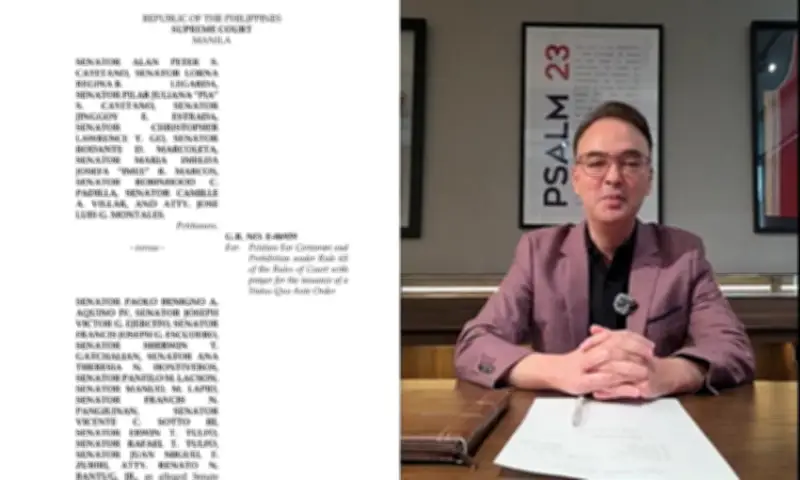
Senator Alan Peter Cayetano and eight other senators filed a petition before the Supreme Court on June 16, 2026, seeking to declare the June 3 plenary session null and void. The petitioners include Senators Loren Legarda, Pia Cayetano, Jinggoy Estrada, Bong Go, Rodante Marcoleta, Imee Marcos, Robin Padilla, and Camille Villar, along with Attorney Jose Luis Montales. They filed a petition for certiorari and prohibition, urging the Court to issue a Status Quo Ante Order regarding the June 3 session where Senator Win Gatchalian was elected acting Senate President and Senate President Pro Tempore.
Key Events Challenged
The petition calls for reverting conditions before the June 3 session, which produced the following actions: the session called by Gatchalian; the declaration of a quorum; the approval of a motion declaring all elective Senate positions vacant; the election of Gatchalian as Senate President Pro Tempore and Acting Senate President; the election of Senator Zubiri as Majority Leader; the election of Attorney Renato Bantug Jr. as Senate Secretary; the election of Alfredo Corpus as Sergeant-at-Arms; the designation of senators as committee chairs; the adoption of Proposed Senate Resolution No. 430 (432) and Senate Resolution No. 48 amending impeachment trial rules; and the adoption of Senate Concurrent Resolution No. 10 to adjourn sine die the First Regular Session of the 20th Congress.
Respondents Named
Respondents include Senators Bam Aquino, Jinggoy Estrada, Chiz Escudero, Risa Hontiveros, Panfilo Lacson, Lito Lapid, Francis Pangilinan, Vicente Sotto III, Erwin and Raffy Tulfo, and Juan Miguel Zubiri.

The petition also asks the Supreme Court to recognize Cayetano as Senate President, Legarda as Senate President Pro Tempore, and all committee chairs prior to June 3.
In a social media post, Cayetano emphasized that the petition is not about the Senate leadership issue but about preserving institutions and defending the Senate's independence as a co-equal branch of government. He stated, "If constitutional rules can be disregarded whenever they become inconvenient, then every future investigation, every future oversight function, and every future effort to hold power accountable becomes vulnerable to the same treatment." He added, "If the rules can be changed in the middle of the game, then no institution remains truly independent and no investigation remains truly secure."