
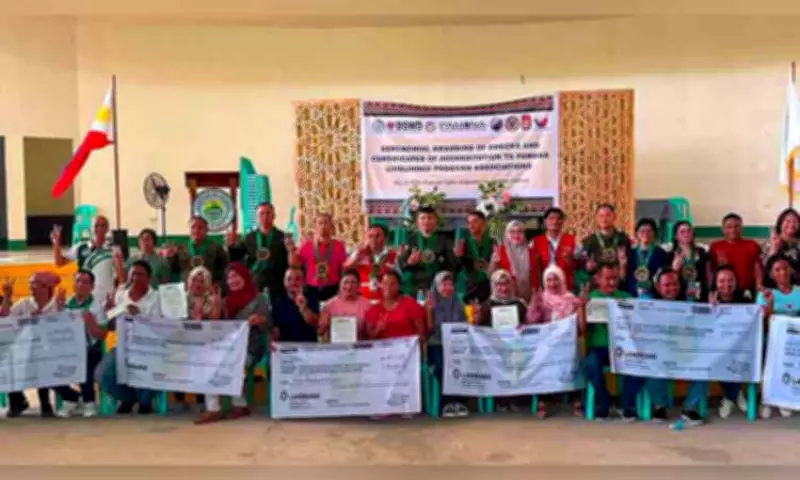
The national government's Transformation Program continues to expand and gain momentum following the recent turnover of P11.7 million in socio-economic assistance to former rebel (FR)-led people's organizations (POs) based in Region 12.
Presidential Adviser Highlights Progress
Presidential Adviser on Peace, Reconciliation, and Unity Secretary Mel Senen Sarmiento announced that the Office of the Presidential Adviser on Peace, Reconciliation, and Unity (OPAPRU) successfully delivered socio-economic commitments under the Transformation Program framework in key Mindanao provinces. The assistance was provided as seed capital for livelihood initiatives to several FR-led POs.
Collaborative Effort for Livelihood Support
In the second week of May, OPAPRU, together with the Department of Social Welfare and Development Field Office XII (DSWD) and provincial government units in Region 12, awarded checks and certificates of accreditation to qualified PAMANA Livelihood Program Associations (PLPAs). These funds aim to support enterprise development initiatives. The OPAPRU's Payapa at Masaganang Pamayanan (PAMANA) Program National Project Management Office provided funding for the socio-economic intervention. The CPP-NPA-NDF Peace Process Office, one of the agency's peace tables, endorsed the list of eligible FR-led POs.

Validation and Profiling of Beneficiaries
The Area Management Unit–South-Central Mindanao (AMU-SCM), under the Local Conflict Transformation–Field Implementation Support Unit–Mindanao (LCT-FISU Mindanao), conducted validation and initial profiling of the FR-led POs to ensure efficient delivery of interventions. In Region 12, the P11.7 million in socio-economic aid was distributed to 37 FR-led organizations across South Cotabato, Sarangani, Cotabato, and Sultan Kudarat provinces. This initiative aims to strengthen the implementation of the OPAPRU's Transformation Program in non-BARMM areas.
Livelihood Projects by Province
- Cotabato Province: Livelihood projects include agricultural and agrivet supply enterprises, rice retailing, mini-groceries, and livestock-related ventures such as frozen meat production.
- Sarangani Province: Diversified activities include goat raising, general merchandise stores, mini-groceries combined with agricultural supply services, agri-vet supply businesses, and rice wholesale operations.
- South Cotabato: Focused on rice retailing, mini-groceries, agri-vet supply, general merchandise, and swine fattening enterprises to strengthen local community-based economic activities.
- Sultan Kudarat Province: Recorded the largest number of beneficiary associations and livelihood projects, prioritizing agri-vet supply stores, general merchandise businesses, grocery operations, and mixed agri-commercial enterprises, alongside specialized projects such as community-based coffee processing and chair-and-table rental services.
Several associations in Kalamansig, Palimbang, Lebak, Esperanza, Columbio, and other municipalities received funding to establish sustainable income-generating activities aimed at improving rural productivity, strengthening local trade, and providing economic opportunities for conflict-affected and marginalized communities under the OPAPRU's Transformation and PAMANA Program.
Transformation Program as a PLGU-led Peace Framework
Secretary Sarmiento explained that the Transformation Program is a holistic and localized peace framework anchored on Conflict-Sensitive and Peace-Promoting (CSSP) approaches. In the absence of a peace agreement with the CPP-NPA-NDF, the program aims to address the needs of FRs, their families, and communities through four components: Security, Confidence Building, Healing and Reconciliation, and Socio-Economic Intervention. These pillars, with local governments at the forefront, seek to ensure legal and physical protection, restore trust in the state, repair the social fabric of communities, and provide sustainable livelihood.

“This localized strategy ensures that the transition from conflict to civilian life is not merely a surrender, but a holistic evolution supported by the provincial government to address the root causes of insurgency at the grassroots level,” Sarmiento said, emphasizing that all interventions are pursued through a whole-of-government, whole-of-nation approach.
Positive Peace and Human Capital
Sarmiento noted that when local governments spearhead the four components, they actively cultivate the “attitudes, institutions, and structures” that sustain a peaceful society, ensuring every former rebel has a stake in a thriving, equitable community. “Under the guidance of President Marcos, Jr., our goal is not merely putting an end to armed conflict but the cultivation of a lasting, positive peace. By bringing the government closer to the people through the Transformation Program, we are proving that good things happen to those who walk the path of peace,” the peace adviser said. He added that the program strengthens human capital through healing, capacity-building, and socio-economic support, enabling beneficiaries to rebuild their lives as peaceful and productive members of society.
Outcomes-Based Approach
Sarmiento underscored a shift toward an “outcomes-based” rather than “input-based” approach, emphasizing tracking the actual impact on people's lives through inclusive development and community-driven interventions. “We must look beyond the initial inputs and focus on the lasting outcomes in communities that are recovering from conflict,” he said. “By prioritizing the growth of human capital and the creation of equitable opportunities, the program ensures that development is not a top-down process but a localized success story. Our initiative seeks not only to improve household incomes but also to institutionalize long-term community resilience and self-sufficiency.”
Monitoring of Beneficiaries
Atty. Elisa Evangelista-Lapina, Officer-in-Charge of the Office of the Executive Director for Local Conflict Transformation, said LCT-FISU Mindanao will collaborate with DSWD 12 to track the socio-economic outcomes of the 39 FR-led POs that initially received P300,000 each. “By shifting from an ‘input-based’ model to one that measures the actual growth of human capital within these 39 FR-led associations, the government is building the resilience of communities against conflict and the recovery efforts of the communist group,” Evangelista said. In Region 12, the Transformation Program has supported FR-led POs such as the Tamayao Kasbakas PAMANA Livelihood Program Association in Sarangani and the MIPAFA in Cotabato. These organizations are utilizing PAMANA and Peace and Development – Buong Bansa Mapayapa (PDBBM) financial assistance to establish various livelihood ventures ranging from general merchandise stores and portable gasoline stations to common service facilities for farming.
By focusing on these POs as primary vehicles for change, Evangelista said LCT-FISU Mindanao ensures that “whole-of-government support reaches the grassroots, turning the four pillars of the Transformation Program into a lived reality for the beneficiaries in Cotabato and hundreds more across the SOCCSKSARGEN region.” LCT-FISU Mindanao is a unit under the CPP-NPA-NDF Peace Process Office that oversees and provides strategic guidance to the Area Management Units in Regions 9, 10, 11, 12, and 13, known as former strongholds of the CPP-NPA-NDF.