

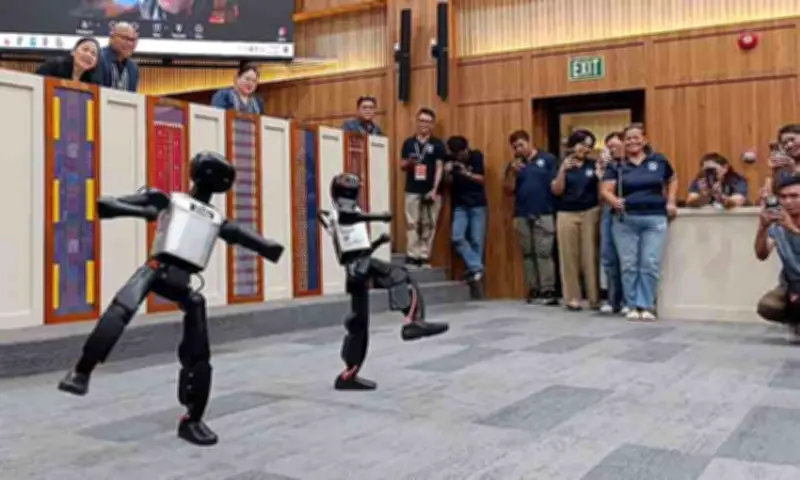
Davao City is taking a bold step into the future of technology as local officials collaborate with artificial intelligence (AI) experts to streamline governance and public services. During a session of the Sangguniang Panlungsod on June 2, 2026, two AI-powered robots entertained council members by dancing to Michael Jackson's "Billie Jean," showcasing the potential of advanced automation in city operations.
AI Integration in Local Government
Councilor Bonz Andre Militar, chairperson of the committee on information technology, emphasized that partnering with AI specialists will ease the city's transition into this new technological era. He highlighted that the city has already passed several landmark ordinances on digitalization, and the next logical step is to deploy AI in government offices. This technology can analyze data for urban planning and process requests more efficiently, reducing bureaucratic delays.
"To make this transition successful, we need the help of experts. We need partners who know how to train people for future skills and digital systems," Militar said during his privilege speech.

Militar noted that Mayor Sebastian "Baste" Duterte's vision of a digitalized, future-ready city has already eliminated slow processes, long queues, and red tape, making government services more accessible to Dabawenyos.
Addressing Job Displacement Concerns
While some residents worry that AI might replace human jobs, Militar assured that the local government unit (LGU) views technology as a tool to enhance, not replace, human labor. The goal is to create a balanced and happy workforce by using smart digital tools to free employees from repetitive paperwork, allowing them to focus on more meaningful tasks.
"The LGU does not see technology as a replacement for its workers; rather, it sees it as a tool to help workers do more," Militar emphasized.
AI Robots in Action
The robots, presented by East West International Education Specialists Inc. (EWIES), can translate up to 200 languages and respond to selected queries. They require one hour of charging and can operate for four hours using lithium batteries. Manufacturing each robot costs about P1 million, excluding programming, but the company expects prices to drop in the coming years.
Militar said these robots are cheaper than other models like Neo, and the city already uses more expensive robots in the Public Safety and Security Office (PSSO). The number of AI robots to be procured will depend on the allocated budget.
Versatile Applications
Dennis Franco M. Layug, president of EWIES, outlined the robots' potential uses, including security, facial recognition, reminders, and even tutoring. The company also offers robot dogs that can detect people under rubble during disasters, identify bombs, analyze soil conditions for agriculture, and provide medical advice.
Layug assured that their AI is human-centered, designed to augment, supplement, and complement human work. He stressed that human intelligence remains irreplaceable because robots lack empathy.
Building an AI-Ready Workforce
Militar and Layug both emphasized the importance of upskilling Dabawenyos to become creators of AI platforms, not just users. By training local talent, the city can tap into a global market of AI-related jobs worth P170 million. Layug said that Davao City was chosen for its strong digitalization efforts in local government processes and public services.
"We want Davao to become a center for AI platform development. Councilor Militar is advocating for upskilling and training local talent, as well as recruiting Dabawenyos, so that AI platforms can be built and initiated right here in Davao," Layug said.
AI in Public Safety and Traffic Management
The Sangguniang Panlungsod has already approved several ordinances integrating AI into city services. One landmark ordinance adopts AI facial recognition technology at entry and exit points to bolster public safety and border security. Proposed by Militar, the system will be installed in government buildings, parks, seaports, airports, land terminals, shorelines, and other public convergence areas. It will be linked to law enforcement databases to detect individuals flagged for arrest or surveillance, aiding crime prevention and counterterrorism.

Militar also proposed modernizing the city's traffic management system with AI. Current traffic lights operate on fixed timers, causing congestion and wasted fuel. An AI-driven system would analyze real-time traffic volume and adjust signal timing accordingly, using cameras to monitor intersections and optimize green-light duration.
With these initiatives, Davao City is positioning itself as a leader in AI adoption, aiming to improve quality of life for its residents while preparing them for a technology-driven future.