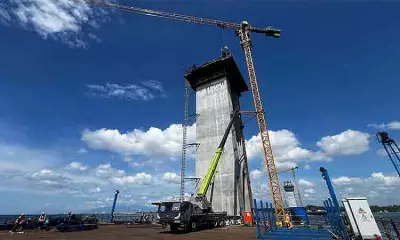
The Cebu Cordova Link Expressway Corporation (CCLEC) is moving forward with a P4-billion plan to build two new ramps designed to skip the heavy traffic at the South Road Properties (SRP). Currently, drivers coming from Mactan often have to take a long, 7-kilometer loop through the SRP even if they don't have business there. The proposed project will create new off-ramp interchanges, allowing drivers to exit the expressway early and head straight into the city.
A Faster, More Efficient Drive
CCLEC President and CEO Engr. Allan Alfon explained that the goal is to create seamless connectivity between the expressway, the SRP, and the airport. This upgrade is expected to save motorists around P1 million in fuel every year and significantly reduce time lost in traffic.
“At present, even if you have no business in SRP, you are forced to go through it,” Alfon said. “With the proposed ramps, you can exit earlier and proceed directly to the city.”

Improving connectivity
The planned interchanges are expected to benefit commuters, tourists, and workers alike. Alfon emphasized that seamless connectivity between the expressway, the SRP, and the airport corridor is critical to maximizing the value of the CCLEX.
He stressed that the expressway and the ramp extensions must be developed together to fully address traffic inefficiencies. A key assurance from CCLEC and city officials is that the project will not require the demolition of any houses. Alfon noted that Cebu City Mayor Nestor Archival directed planners to avoid routes affecting residential areas, particularly in the Kalambuan area of Barangay Mambaling.
Exploring better alternatives
Originally, the CCLEX expansion included a ramp toward V. Rama Avenue. However, this was deemed impractical due to high social and financial costs. Mayor Archival pointed out that the V. Rama route would have required widening congested roads like C. Padilla.
“It would be more complex and costly. It will take time and a lot of resources,” Archival said. Instead, the city is prioritizing the SRP-side extensions as an immediate solution. Alfon estimated the project would save motorists roughly P1 million in fuel annually and reduce losses caused by traffic delays.
The ramp extensions are estimated to cost P4 billion under a public-private partnership. The project could be completed within 18 months once construction begins, pending approval from the City Council. Alfon confirmed that CCLEC has already engaged a designer to finalize engineering plans. “It’s critical that the construction permit be issued right away once plans are ready,” he said.
Protecting the Environment
Construction is expected to be less disruptive to residents because much of the work will be done offshore. Alfon explained that dredging and pile driving will take place in the water, resulting in minimal impact on the surrounding communities.
CCLEC assured the public that environmental safeguards will be in place to protect marine ecosystems. In the long term, officials believe the ramps will be a major part of Cebu’s urban mobility strategy. “This is a practical solution we can implement now while preparing for bigger infrastructure in the future,” Alfon said.