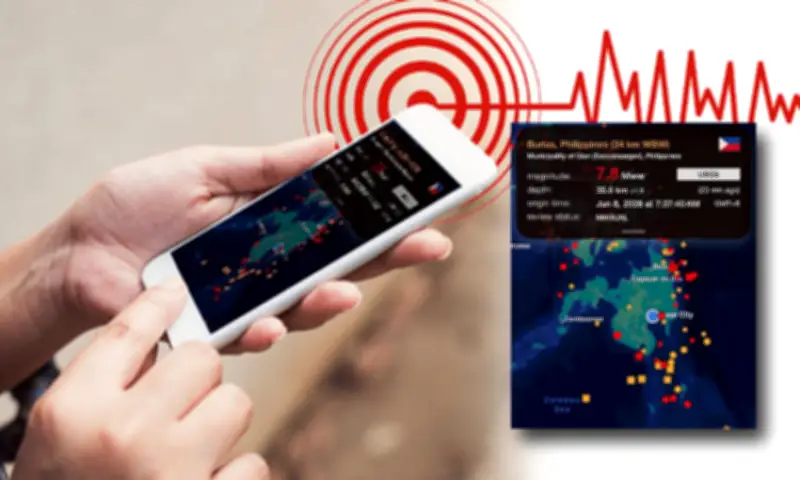
Android smartphones can function as "little seismometers," helping warn users of possible earthquake shaking seconds before it occurs, according to the Philippine Institute of Volcanology and Seismology's (Phivolcs) Mindanao Cluster Monitoring Center for Earthquake and Tsunami (PMCMCET).
How Android Earthquake Alerts Work
Edward Louise Orquillas, science research assistant at PMCMCET, explained during a press briefing on July 3, 2026, at the Pinnacle Hotel in Davao City that Android phones now act as little seismometers. He noted that Android users in General Santos City did not receive earthquake alerts because they were located near the earthquake's epicenter. However, users in Davao City and other surrounding areas received advance notifications after Android devices closer to the epicenter detected the initial ground movement.
Orquillas said the Android Earthquake Alerts System works by allowing participating Android phones to detect sudden ground shaking. The data are then transmitted to Google's servers, which analyze the information and send alerts to users in areas expected to experience shaking.

Not Earthquake Prediction
Orquillas emphasized that Android phones do not predict earthquakes. Instead, they rely on information gathered from thousands of Android devices that detect seismic activity in real time. This is why earthquake notifications typically indicate that users "may experience light shaking" rather than predicting the exact intensity of an earthquake.
He also noted that Android smartphones are not designed as scientific instruments for measuring earthquakes. Rather, the system uses data from seismographs and other monitoring sources to estimate potential ground shaking. Since every earthquake differs in magnitude, depth, and epicenter, the alerts cannot provide exact measurements.
Earthquakes Harder to Forecast Than Typhoons
Orquillas acknowledged that earthquakes remain far more difficult to forecast than weather disturbances. Unlike typhoons, whose movements can be monitored and projected days in advance, there is currently no technology capable of detecting underground pressure or accurately determining when tectonic plates will suddenly move.
"What we can do is identify active faults and closely monitor areas where strong earthquakes have previously occurred," he said, adding that earthquakes cannot yet be predicted with certainty.
Seismographs Still Essential
For precise earthquake measurements, Orquillas said dedicated seismographs remain indispensable. He explained that seismographs are installed underground—typically at least six feet deep, and in some cases more than 100 meters below the surface—to accurately record seismic activity.
Recent Earthquake and User Experience
On June 8, 2026, a magnitude 7.8 earthquake struck off the coast of Maasim, Sarangani, at 7:37 a.m. The tremor was felt across several parts of Mindanao, prompting Phivolcs to issue a tsunami warning. Following the earthquake, many Android users reported receiving earthquake notifications several seconds before the shaking began. Some said the alert gave them enough time to prepare, while others were able to evacuate to safer areas before the strongest shaking occurred.
Android's Official Statement
According to Android's official website, the Android Earthquake Alerts System is designed to help users "respond faster and smarter during an emergency." The company stated, "Powered by the Android Earthquake Alert System, every Android device is a mini-seismometer, making up the world's largest mobile earthquake detection network."
Android said the feature can notify users seconds before earthquake shaking begins, giving them valuable time to seek safety. It also provides guidance on what users should do after an earthquake. The Android Earthquake Alerts System is currently available in multiple countries.