Former President Duterte Files Waiver to Avoid ICC Hearing, Challenges Court's Authority
In a significant legal move, former Philippine President Rodrigo Duterte has formally submitted a waiver to excuse himself from attending the upcoming confirmation of charges hearing at the International Criminal Court (ICC). The hearing is scheduled to take place from February 23 to 27, 2026, but Duterte's decision underscores his ongoing defiance of the international judicial body.
Duterte Rejects ICC Jurisdiction and Accuses Current Administration
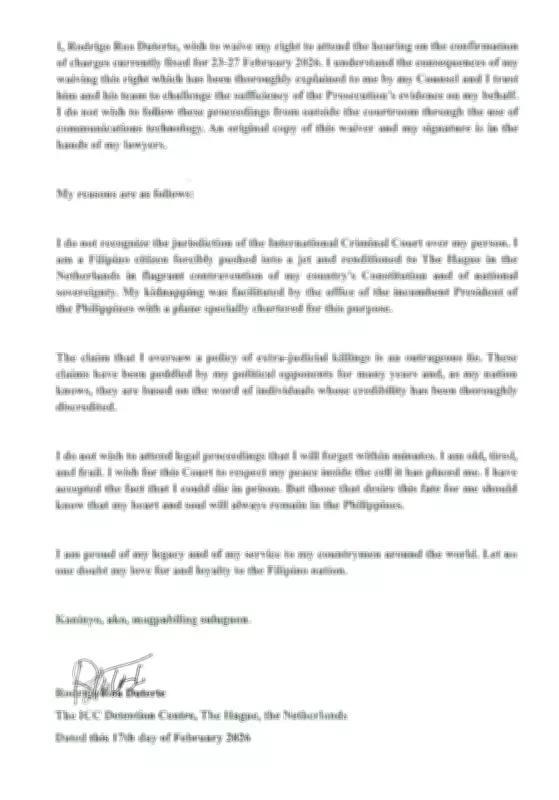
In a letter dated February 17, 2026, sent from the ICC Detention Centre, Duterte explicitly stated that he does not recognize the jurisdiction of the ICC over his case. He argued that the court has no legal authority to prosecute him, framing the proceedings as illegitimate. Additionally, Duterte made serious accusations against the current Philippine administration, alleging that it was behind what he described as his kidnapping or forced rendition to the Netherlands for the hearing.
This claim adds a layer of political tension to the situation, suggesting internal conflicts within the Philippine government regarding international legal matters. Duterte's allegations imply that domestic forces are collaborating with the ICC, a point that could have broader implications for the country's foreign relations and internal politics.

Denial of Charges and Health Concerns Cited
Duterte vehemently denied the charges related to extra-judicial killings, which have been a central issue in the ICC's investigation. He labeled these accusations as an outrageous lie, maintaining his innocence and defending his controversial policies during his presidency. The former leader has long been criticized for his war on drugs, which resulted in thousands of deaths, but he has consistently dismissed such criticisms as unfounded.
Beyond the legal and political arguments, Duterte cited his age and poor health as primary reasons for not attending the hearing. At his advanced age, he claimed that travel and participation would be physically taxing, potentially exacerbating his medical conditions. This personal aspect highlights the human element in the high-stakes legal battle, though it does not diminish the gravity of the charges against him.
Delegation to Legal Counsel and Final Remarks
In his waiver, Duterte expressed his willingness to face any consequences that may arise from his decision, demonstrating a defiant stance. He has entrusted his legal counsel with the responsibility of challenging the prosecution's evidence on his behalf, indicating a strategic move to continue his defense without his physical presence. Duterte emphasized that his heart remains in the Philippines, reinforcing his connection to the nation despite the international scrutiny.
This development marks a critical juncture in the ICC's case against Duterte, as his absence could complicate the proceedings. Legal experts suggest that waivers like this are rare in such high-profile international cases, and it may influence how the court handles future similar situations. The hearing is expected to proceed as scheduled, but Duterte's waiver will likely be a focal point of discussions, both in legal circles and among the public.