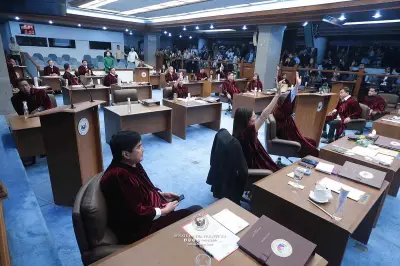
The Supreme Court of the Philippines has delivered a severe verdict, ordering the dismissal and disbarment of a judge found guilty of plotting the murder of a fellow magistrate. This landmark decision underscores the principle that no one, not even members of the judiciary, is above the law.
The Crime and Conviction
In a case that shocked the legal community, former Presiding Judge Oscar D. Tomarong of Branch 28, Regional Trial Court (RTC) in Liloy, Zamboanga del Norte, was found administratively liable for the murder of Judge Reymar L. Lacaya. Judge Lacaya served as the presiding judge of Branch 11, RTC, in Sindangan, Zamboanga del Norte.
The tragic incident occurred in 2019. After attending a hearing at Branch 28 one afternoon, Judge Lacaya was walking to his parked car behind the courthouse when gunshots rang out. He was found dead beside his vehicle.

During the criminal trial against Tomarong, key testimony came from Juliber Cabating, a public works employee who acted as the judge's aide. Cabating testified that Judge Tomarong instructed him to hire assassins to kill Judge Lacaya. Furthermore, he stated that Tomarong provided P250,000 through him as payment for the hired killers.
Supreme Court's Administrative Ruling
While Judge Tomarong's criminal conviction for murder is under appeal, the Supreme Court proceeded with the administrative case independently. The Court emphasized that a final criminal conviction is not required to impose administrative penalties. In disciplinary proceedings, what is needed is substantial evidence, a standard separate from the proof beyond reasonable doubt required in criminal cases.
The High Court found substantial evidence proving Tomarong's guilt. Beyond Cabating's testimony, another witness placed himself with the hired killers on the morning of the murder. An additional witness saw the assailants fleeing the court building after the shooting.
The Court declared that murder is a crime involving moral turpitude, defined as acts that are "grossly immoral, dishonest, and go against one’s duty to society." This serves as a ground for dismissal from service under the Rules of Court.
Severe Penalties and Final Disqualification
The Supreme Court imposed the maximum administrative penalties on the former judge:
- Dismissal from the service.
- Forfeiture of all retirement benefits.
- Disbarment from the practice of law.
- Perpetual disqualification from re-employment in any government agency.
The Court stated that Tomarong's actions represented the gravest violation of a judge's duty, especially as it was committed against a colleague. In a powerful statement, the ruling noted: "At a time when the rise in the attacks against judges has even necessitated the adoption of measures to protect judges, a judge committing the murder of a fellow judge must be punished swiftly and severely."
Regarding his disbarment, the Court ruled that a lawyer who shows contempt for the sanctity of human life is unfit to remain a member of the legal profession. This action aligns with the Code of Professional Responsibility and Accountability, which prohibits lawyers from engaging in unlawful, dishonest, or immoral acts.
A Message on Judicial Integrity
This ruling sends a clear message about the accountability of those who sit on the bench. The Supreme Court asserted, "No one, not even members of the Bench, is above the law." It further explained that judges are the embodiment of law and justice, and public trust is undermined when they violate the very laws they are sworn to uphold.
The case, identified as Judicial Integrity Board v. Presiding Judge Oscar D. Tomarong (A.M. No. RTJ-25-085) and promulgated on July 29, 2025, stands as a stark reminder of the high ethical standards demanded of the judiciary and the Court's commitment to enforcing them without exception.