Cebu City's planned return to the Binaliw landfill remains under review as the City Government continues validating environmental and technical requirements imposed before dumping operations can resume at the facility.
Task Force Inspection
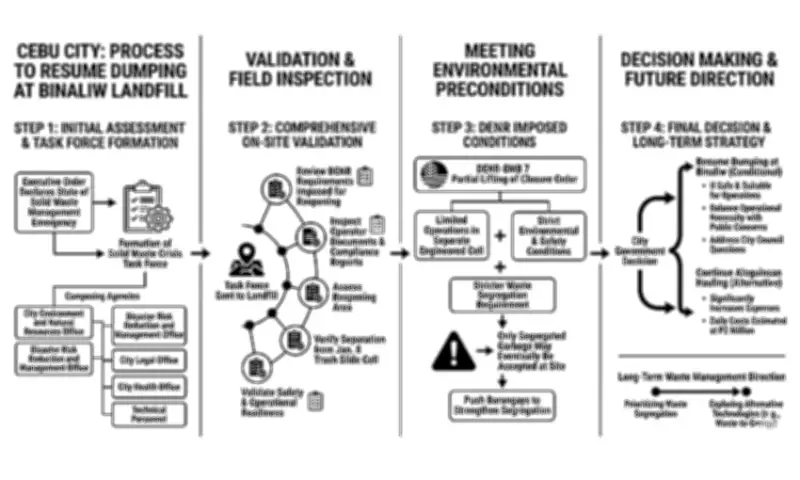
Mayor Nestor Archival confirmed that members of the City's newly formed Solid Waste Crisis Task Force were sent to inspect the landfill and assess whether the reopened portion complies with conditions set by the Department of Environment and Natural Resources (DENR) 7.
The task force, created under an executive order declaring a state of solid waste management emergency in Cebu City, is composed of representatives from the City Environment and Natural Resources Office, Disaster Risk Reduction and Management Office, City Legal Office, City Health Office and other technical personnel tasked with validating the safety and operational readiness of the facility.

Safety Validation
Archival said the team will review the requirements imposed by the DENR, inspect documents submitted by the landfill operator and assess whether the area being reopened is separate from the portion affected by the deadly Jan. 8 trash slide that killed 36 people and injured several others.
"They will check what requirements were set by the DENR and what documents were submitted. They will also inspect the actual area being opened, whether it is the same area that experienced the landslide in January or a different cell," Archival said.
He explained that the Cebu City Government wants to ensure the reopened area is safe and suitable for operations before making a final decision.
"If it is not appropriate for us to use, then we will have to find another alternative and possibly return to Aloguinsan," he added.
Continuing to haul garbage to Aloguinsan would significantly increase expenses for the City, with daily hauling and disposal costs estimated at P2 million, Archival noted.
Waste Segregation
The DENR imposed conditions before allowing the partial reopening of the landfill, including stricter waste segregation requirements. Only segregated garbage may eventually be accepted at the site, prompting the City to push barangays to strengthen segregation measures before disposal.
"That is one of the situations they are looking at. If that is the case, we will really have to force the barangays to comply with segregation or else they may not be allowed to dump there," he said.
Archival clarified that while the City initially targeted an immediate resumption of dumping operations at Binaliw after its contract with Aloguinsan ended, the move was temporarily halted due to concerns raised by various sectors, including the City Council.
"Our target was actually yesterday (Sunday, May 17), because our contract had already been consumed. But there were many questions, so we stopped first so those concerns could be addressed," he said.
Landfill Controversy
The mayor acknowledged that the reopening remains controversial following the Jan. 8 disaster, which triggered investigations and a cease-and-desist order from the environmental agency.
The Environmental Management Bureau (EMB) 7 earlier partially lifted the closure order, allowing limited operations in a separate engineered landfill cell under strict environmental and safety conditions while rehabilitation efforts continue after the operator completed remediation measures. Still, Archival said the Cebu City Government continues to balance operational necessity with public concerns.
"There are still many questions, but I am doing the best I can to satisfy all concerns," he said.
Temporary Storage
The mayor also defended the temporary use of the South Road Properties (SRP) as a waste holding area, noting the City currently has limited disposal options. The arrangement has led to recurring complaints over odor and environmental concerns at the SRP, where around 18,000 tons of waste are stockpiled — down from the 21,000 tons accumulated during the peak of the garbage crisis.
Containment measures are being implemented to minimize environmental risks while the City works on transferring the waste elsewhere, Archival said.
"If there are people criticizing us, then tell us where we should place the garbage," he said.

The mayor reiterated that Cebu City is prioritizing waste segregation as part of its long-term solid waste management direction. While he remains open to waste-to-energy technology, Archival said such projects take three to five years to implement and face public resistance.
"As long as it is within the bounds of the law, I don't think we have a problem with waste-to-energy. But it takes three to five years," he said.
Instead, the City is focusing on segregation and alternative technologies that may gain wider public acceptance before presenting proposals to the City Council.