
ADB Pledges USD1.75B to Aid Philippines in Crisis
The Asian Development Bank commits USD1.75 billion in additional financing to help the Philippines mitigate economic shocks from the Middle East conflict, including rising oil prices.


The Asian Development Bank commits USD1.75 billion in additional financing to help the Philippines mitigate economic shocks from the Middle East conflict, including rising oil prices.

A new UN report reveals the Middle East conflict is disrupting energy, trade, and connectivity, slowing growth and raising inflation in Asia-Pacific. The region remains the fastest-growing but faces challenges from global uncertainty and rising costs.

Exploring how capitalism and personal initiative have driven global prosperity since the Industrial Revolution, lifting billions from poverty through wealth creation rather than redistribution.

Finance Secretary Frederick Go emphasized the need for expanded financing, job creation, and climate resilience for developing economies facing geopolitical and climate pressures at the G-24 meeting.

Shared lists with real-time sync. No signup needed — just open and shop together.
Recommended
Inflation in the Philippines has surged to 4.1% by mid-April 2026, up from 2.4% two months ago, driven by rising fuel and transport costs linked to Middle East tensions. This increase is impacting daily expenses like rice and electricity, forcing families

ASEAN finance ministers and central bank governors have reaffirmed the region's economic resilience against global shocks, endorsing plans for capital markets, payments connectivity, and sustainable finance at a key meeting in the Philippines.

The IMF's Global Financial Stability Report highlights increased risks from the Middle East war, bond market volatility, and AI disruption, urging urgent policy actions.

The IMF projects Philippine economic growth at 4.1% for 2026, down from earlier forecasts, citing the Middle East conflict, corruption scandals, and global risks.

Despite soaring global gas and oil prices impacting daily life in the Philippines, Filipinos demonstrate remarkable resilience through positivity, community support, and cultural strength.
Shared lists with real-time sync. No signup needed — just open and shop together.
Recommended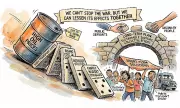
The ongoing US-Iran conflict is impacting the Philippines economically, with rising oil prices severely affecting public transport drivers and causing a domino effect on basic goods. Experts call for long-term government solutions and collective action.

The Philippine economy is forecast to grow 5.3% in 2026, ranking second in ASEAN, but Middle East conflicts could drive inflation higher, warns Amro.

As global economic conditions become more volatile with rising geopolitical tensions and tightening capital, today's leaders face unprecedented tests requiring strategic judgment under uncertainty rather than operational competence alone.

The G7 has called on international organizations to evaluate how Middle East tensions affect energy markets and global trade, as economic growth forecasts are revised downward globally.

The International Energy Agency warns the global economy faces a major threat from energy crisis due to Middle East tensions, particularly in the Strait of Hormuz, comparing it to 1970s oil crises and Russia-Ukraine war impacts.
Shared lists with real-time sync. No signup needed — just open and shop together.
Recommended
The ongoing Iran conflict is triggering severe economic shocks globally, with fuel prices skyrocketing, inflation rising, and millions of Overseas Filipino Workers facing job insecurity and safety concerns.

Global tensions in the Middle East are not just about military clashes—they directly impact Davao's gas prices, agricultural costs, and financial stability through oil markets and supply chains.

As ASEAN chair, the Philippines advocates to formalize the Geoeconomics Task Force into a permanent body, enhancing regional coordination amid global economic uncertainties and geopolitical tensions.

The IMF projects Philippine economic growth at 5.6% in 2026 and 5.8% in 2027, citing reforms and resilience. Managing Director Kristalina Georgieva highlights risks from Middle East tensions and calls for renewable energy investments.

The Mindanao Alliance for Progress warns that Middle East conflicts could disrupt global oil markets, leading to higher fuel and commodity prices in the Philippines. They urge authorities to monitor prices and protect consumers from profiteering.
Shared lists with real-time sync. No signup needed — just open and shop together.
Recommended
A total deployment ban on Overseas Filipino Workers in the Middle East could cost the Philippine economy over P226 billion, impacting remittances and national financial stability.

A DTI official highlights how Middle East conflicts and US-China trade tensions create openings to enhance trade policies, as the Philippines chairs ASEAN and hosts a key business forum.

The ongoing conflict between Iran and US-Israel threatens to exacerbate inflation, weaken the peso, and disrupt OFW remittances, potentially pushing the Philippines toward recession.

The Philippine Chamber of Commerce and Industry expresses grave concern over escalating Middle East military tensions, warning of severe impacts on oil prices, OFW remittances, and inflation in the Philippines.

President Ferdinand R. Marcos Jr. emphasizes the need for intensified cooperation among ASEAN nations to restore the bloc's role as a global economic driver, focusing on strengthening internal supply chains during the Philippines' chairmanship.
Shared lists with real-time sync. No signup needed — just open and shop together.
Recommended
President Ferdinand Marcos Jr. emphasizes the need for ASEAN nations to fortify supply chains and boost intra-regional trade, citing lessons from the COVID-19 pandemic and aiming to enhance economic resilience.

Global analysts project the Philippines could become one of the world's 20 largest economies by 2050, but political instability, corruption, education gaps, infrastructure bottlenecks, and climate vulnerability pose significant threats to this potential g

EU leaders agree to fast-track efforts to strengthen the single market, with a roadmap due in March and potential enhanced cooperation among at least nine member states if progress stalls.

APEC projects Asia-Pacific economic growth at 3.2% in 2025, easing to 3.1% in 2026, driven by resilient consumption and AI investment, but warns of trade fragmentation and geopolitical risks.

Singapore's economy expanded by five percent in 2025, slightly down from 5.3% in 2024. The Ministry of Trade and Industry has upgraded its 2026 growth forecast to 2-4%, citing a stronger global economy and resilient trade.
Shared lists with real-time sync. No signup needed — just open and shop together.
Recommended
The British Chamber of Commerce of the Philippines calls on the country to leverage its ASEAN chairmanship to enhance regional economic integration, digitalization, and trade liberalization.
