

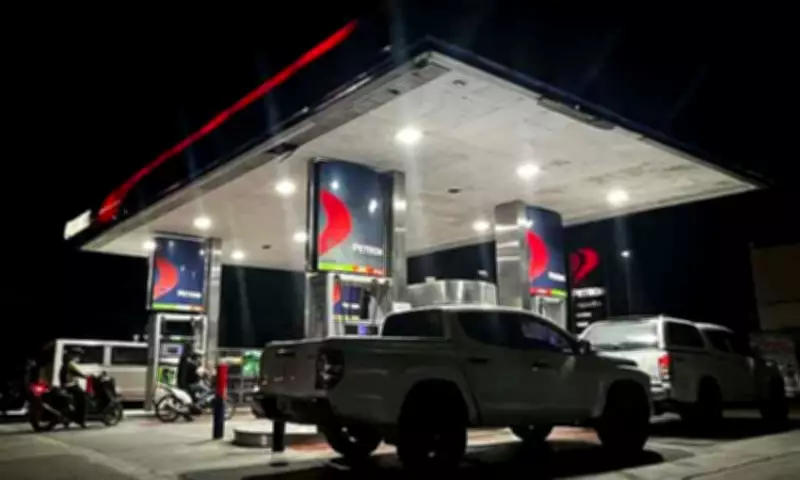
Philippines Braces for Steepest Fuel Price Hike in Recent Years
The Department of Energy (DOE) has announced that fuel prices in the Philippines are set to surge to some of their highest levels in recent years, following another round of significant price increases by oil companies this week. Energy Secretary Sharon Garin, in a virtual press conference on Monday, March 16, 2026, stated that diesel prices could climb to as high as P114 per liter starting Tuesday, March 17, depending on pump prices recorded by individual fuel retailers in the previous week.
Details of the Price Adjustments
The DOE described this adjustment as one of the steepest fuel price hikes recorded in recent months, driven largely by volatility in the global oil market and rising geopolitical tensions in the Middle East. Based on agency monitoring, diesel prices may range between P95 and P114 per liter, while gasoline prices could reach as high as P91.60 per liter after the new adjustments take effect.
Garin explained, "Depende sa gas station. May mga gas stations na nagbebenta last week ng diesel na P70, may nagbenta ng P90. Kung P70 ka last week, ang pinakamataas mo na ma-charge is P94 pero kung nagbenta ka ng P90 last week, posible ka mag-charge ng P114."

The agency released estimated fuel price adjustments for the period of March 17 to March 23. Based on monitoring of international oil prices, diesel prices are expected to increase by P20.40 to P23.90 per liter, while gasoline prices may rise by P12.90 to P16.60 per liter. Meanwhile, kerosene prices are projected to go up by P6.90 to P8.90 per liter during the same period.
Oil Companies Implement Staggered Hikes
With the latest round of increases, Garin said diesel prices could reach P114.90 per liter, marking one of the highest pump price levels seen in the country since the global energy crisis in 2022. Several major oil companies operating in the Philippines have already announced their respective price adjustments.
French energy company TotalEnergies said gasoline prices would increase by P114.10 per liter, while diesel prices would rise by P20.70 per liter. Meanwhile, Shell Pilipinas and Seaoil Philippines confirmed steeper increases in line with global market movements.
Shell stated it would raise gasoline prices by P16.20 per liter and diesel prices by P23.90 per liter, with kerosene increasing by P6.90 per liter. Seaoil announced a similar adjustment, increasing gasoline prices by P16.20 per liter and diesel prices by P23.30 per liter.
According to the companies, the new price adjustments will take effect on a staggered basis. Total and Seaoil implemented the changes starting March 18, while Shell, along with local retailers such as Petron Corporation and Flying V, scheduled their adjustments until March 19.
Regional Price Variations and Deregulated System
The DOE noted that pump prices may vary widely depending on the location and operational costs of each retailer. Energy officials highlighted that prices in Metro Manila and other major urban areas could differ from those in remote provinces due to logistics and transportation costs.
Garin added that isolated areas, particularly island provinces such as Batanes, may experience higher pump prices because fuel must be shipped from mainland depots. The Philippine fuel industry operates under a deregulated system following the implementation of the Oil Deregulation Law, which allows oil companies to independently set their pump prices based on market conditions.
As a result, actual retail prices depend on factors such as inventory levels, distribution costs, and the timing of each company’s price adjustments.
Global Tensions Drive Oil Volatility
The latest spike in domestic fuel prices comes amid rising geopolitical tensions affecting the global energy supply chain. The DOE said the price increases are part of a staggered adjustment triggered by escalating instability in the Middle East, particularly around the Strait of Hormuz, one of the world’s most critical oil transit routes.

Roughly 20 percent of the global oil supply passes through the Strait of Hormuz, making disruptions in the area a major concern for energy-importing countries like the Philippines. Recent tensions involving the United States, Israel, and Iran have fueled uncertainty in international energy markets, pushing benchmark crude prices upward.
The Philippines imports nearly all of its petroleum requirements, making domestic fuel prices highly sensitive to global supply disruptions.
Supply Adequacy and Potential Risks
Despite the steep price increases, the DOE assured the public that the country still has an adequate fuel supply. Government monitoring shows that oil inventories held by fuel companies remain within normal levels and are sufficient to meet current demand.
However, Garin warned that panic buying or hoarding by businesses and consumers could strain supplies, particularly for sectors heavily dependent on diesel, such as public transportation and logistics. She emphasized, "What is unpredictable is the hoarding part. Kung mag-hoard ang isa, maapektuhan ang iba, especially ang PUVs. We need to curtail hoarding and not cause more panic among our people."
Public utility vehicles (PUVs), which rely heavily on diesel, are among the sectors expected to feel the most immediate impact of the fuel price surge. Transport groups have already raised concerns that sustained increases could trigger fare adjustment petitions if prices continue to rise in the coming weeks.
Energy officials are also closely monitoring the possibility of tighter supply conditions in the coming months. According to the DOE, the Philippines could face potential supply disruptions between late April and May if geopolitical tensions worsen and exporting nations reduce shipments.
Some foreign suppliers have reportedly begun reviewing or delaying contracts amid uncertainty in global markets. With the country’s energy security heavily dependent on imports, analysts warn that any prolonged disruption in Middle Eastern oil exports could further push up fuel prices and affect inflation, transportation costs, and business operations across the Philippine economy.
For now, the DOE said it will continue coordinating with oil companies and monitoring global developments to ensure stable supply while discouraging panic buying among consumers.